







Scientists have identified an unusual wave-like heat transport mechanism in a crystalline material that could open new possibilities for converting industrial waste heat into electricity.
Researchers from the Jawaharlal Nehru Centre for Advanced Scientific Research (JNCASR), Bengaluru, and their collaborators have observed the phenomenon in a copper chalcogenide material called thallium copper selenide (TlCu5Se3).
The finding could have applications in thermoelectric energy conversion, particularly in sectors that generate large amounts of waste heat, including power plants, cement and steel industries, automobiles and data centres. It could also have potential applications in battery heat management and thermal technologies.
The study has been published in the journal Science Advances.
Confined copper motion key to unusual heat transport
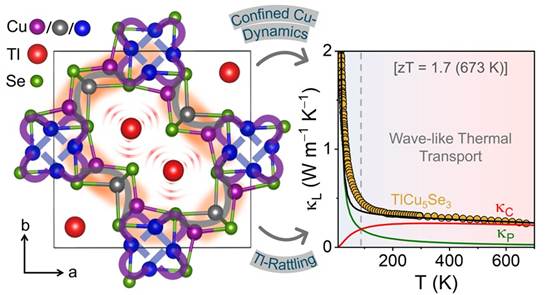
In conventional crystalline materials, heat is primarily transported through particle-like vibrations known as phonons. However, the researchers found that TlCu5Se3 operates in an intermediate regime where heat can also be transported through wave-like coherence between different vibrational modes.
The material’s complex crystal structure restricts the movement of copper atoms within the framework. Instead of undergoing long-range, liquid-like migration as seen in some superionic materials, the copper atoms exhibit localized dynamic disorder.
According to the researchers, this confined motion generates exceptionally strong anharmonicity—irregularities in atomic vibrations that disrupt conventional heat propagation.
As a result, heat transport becomes dominated by wave-like phonon coherence, with phonons effectively tunnelling between localized vibrational states rather than travelling as well-defined particles.
Material achieves thermoelectric figure of merit of 1.7
The unusual thermal behaviour is accompanied by favourable electronic transport properties, resulting in a thermoelectric figure of merit (zT) of 1.7.
The researchers said this places TlCu5Se3 among the highest-performing pristine ternary chalcogenides reported for thermoelectric applications.
The compound crystallises in a tetragonal structure and features a complex three-dimensional, cloverleaf-like knot framework with open channels along the crystallographic c-axis. Its distinctive bonding hierarchy is believed to be responsible for the confined dynamics of the copper sublattice.
Advanced simulations help explain phenomenon
The research was led by Prof. Kanishka Biswas and his Ph.D. students Ms. Sayantoni Choudhury and Dr. Animesh Bhui from the New Chemistry Unit at JNCASR.
The team collaborated with Prof. Umesh V. Waghmare and Dr. Prasad V. Matukumilli from JNCASR’s Theoretical Sciences Unit to investigate the atomic dynamics using first-principles calculations and molecular-dynamics simulations.
The simulations showed that copper atoms remain locally disordered rather than undergoing the extensive migration associated with superionic behaviour.
To understand how heat moves under these conditions, the researchers used a unified framework of thermal transport that accounts for both conventional particle-like phonon propagation and wave-like coherence between different phonon branches.
Potential for industrial waste heat recovery
The researchers said the findings demonstrate how structural complexity and confined ion dynamics can suppress heat transport while maintaining crystallographic stability.
Materials with ultralow lattice thermal conductivity are important for thermoelectric energy conversion, thermal barrier coatings and emerging thermal-management technologies.
The discovery therefore provides a potential new pathway for designing stable materials capable of efficiently converting waste heat into electricity, while also offering insights into unconventional heat transport in complex crystalline systems.


