






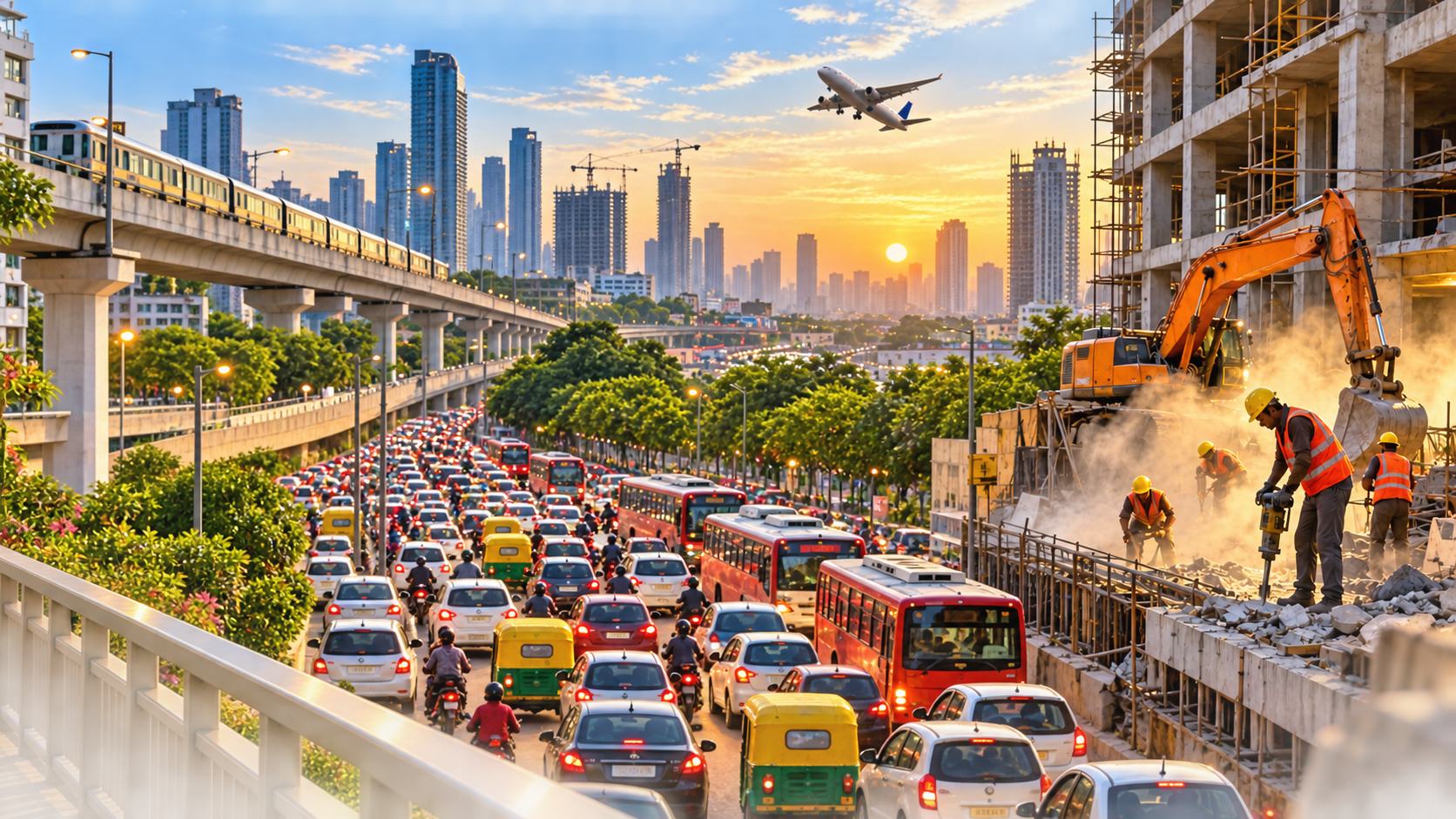
A city has its own soundtrack. The rumble of traffic, the sharp blast of a horn, construction work beginning early in the morning and loudspeakers competing for attention. For millions of people, these sounds have become so familiar that they are often barely noticed. But when the noise continues throughout the day and into the night, it raises a question that goes beyond inconvenience: what does constant exposure to noise do to our health?
In India’s rapidly expanding cities, noise pollution is an increasingly important public-health concern. Growing traffic, construction activity, industrial operations and crowded urban spaces have made it difficult for residents to escape unwanted sound, even in areas meant to be relatively quiet. Research conducted in Delhi and other major Indian cities has recorded noise levels exceeding prescribed limits, highlighting the scale of the challenge.
A 2023 study, Evaluation and Analysis of Environmental Noise Levels in NCT of Delhi, India, examined noise at 100 locations across the national capital between December 2021 and May 2022. The researchers recorded hourly equivalent noise levels ranging from 66.5 to 84.7 decibels. Road traffic and honking emerged as the dominant sources, with 78 per cent of respondents in the accompanying survey identifying traffic noise as the most prominent source of disturbance.
The findings are not limited to Delhi. A separate study published in Archives of Acoustics analysed a decade of environmental noise-monitoring data, from 2011 to 2020, across seven major Indian cities: Delhi, Mumbai, Kolkata, Chennai, Bengaluru, Hyderabad and Lucknow. It found that monitored residential and silence-zone locations did not consistently meet the prescribed ambient noise standards during the period examined.
How noise affects the human body
Noise pollution is not simply about sounds being unpleasant or irritating. Its effects depend on how loud the sound is, how long a person is exposed to it and whether it interferes with activities such as sleeping, studying or working.
The World Health Organization (WHO) identifies environmental noise as an important environmental health risk. Research has associated prolonged exposure with sleep disturbance, cardiovascular problems, cognitive effects and poorer mental well-being.
Sleep is among the first aspects of daily life to be affected. Traffic, aircraft and construction noise can interrupt rest, sometimes without a person becoming fully conscious of the disturbance. Repeated sleep disruption can leave people tired, affect concentration and make it harder to manage everyday demands.
The effects may also extend to the body’s stress-response system. When exposed to disturbing sounds, the body can respond by releasing stress hormones and changing heart rate and blood pressure. Repeated exposure has been associated with an increased risk of hypertension and cardiovascular disease.
Noise can also interfere with concentration and learning. For children, particularly those studying in schools located near busy roads or other noisy environments, unwanted sound can make it harder to follow speech and retain information. In adults, persistent background noise can affect attention and communication at work and at home.
These effects do not occur in the same way for everyone. Exposure levels, individual health, age and the surrounding environment all influence how people experience noise. Nevertheless, the evidence makes clear that long-term exposure deserves attention as a public-health issue.
What is India doing to control noise pollution?
India has a regulatory framework to address excessive environmental noise. The Noise Pollution (Regulation and Control) Rules, 2000, framed under the Environment (Protection) Act, 1986, prescribe permissible ambient noise levels for different categories of areas.
The limits vary according to the area’s classification and the time of day:
| Area category | Daytime limit | Nighttime limit |
|---|---|---|
| Industrial | 75 dB | 70 dB |
| Commercial | 65 dB | 55 dB |
| Residential | 55 dB | 45 dB |
| Silence zone | 50 dB | 40 dB |
Daytime is defined as 6 AM to 10 PM, while nighttime runs from 10 PM to 6 AM.
The Central Pollution Control Board (CPCB) also operates the National Ambient Noise Monitoring Network (NANMN), which tracks environmental noise in major urban centres. According to the Ministry of Environment, Forest and Climate Change’s Annual Report 2024–25, the network covered 10 metropolitan cities through 82 monitoring stations.
The rules also regulate common sources of excessive noise. Loudspeakers and public-address systems require written permission from the designated authority, and their use is generally prohibited between 10 PM and 6 AM, subject to specified exemptions.
Vehicle horns are regulated under the Central Motor Vehicles Rules, 1989, which prescribe permissible sound levels and prohibit multi-toned horns and devices producing excessively harsh, shrill or alarming sounds. According to the Ministry of Road Transport and Highways, the permissible sound level ranges from 83 to 112 dB(A) for two- and three-wheelers with engine power up to 7 kW, and from 87 to 112 dB(A) for other motor vehicles. Unnecessary or continuous honking is also punishable under the Motor Vehicles Act, 1988.
Making room for quieter cities
Reducing urban noise requires more than asking people to stop honking. It calls for attention to how cities are planned, how traffic moves and how construction activities are managed.
Better traffic management, enforcement of vehicle noise standards, quieter construction practices and improved building design can help reduce exposure. Noise barriers along busy roads, better road surfaces and the creation of quieter public spaces can also contribute to healthier urban environments.
Public behaviour matters too. Unnecessary honking, excessive use of loudspeakers and disregard for residential quiet hours add to the everyday noise burden.
As Indian cities continue to grow, urban planning must consider not only roads, housing, transport and air quality, but also the sound environment in which people live.
A city does not have to be silent to be healthy. But its residents should not have to accept constant noise as the unavoidable price of urban life.
-Ranu Jain


