







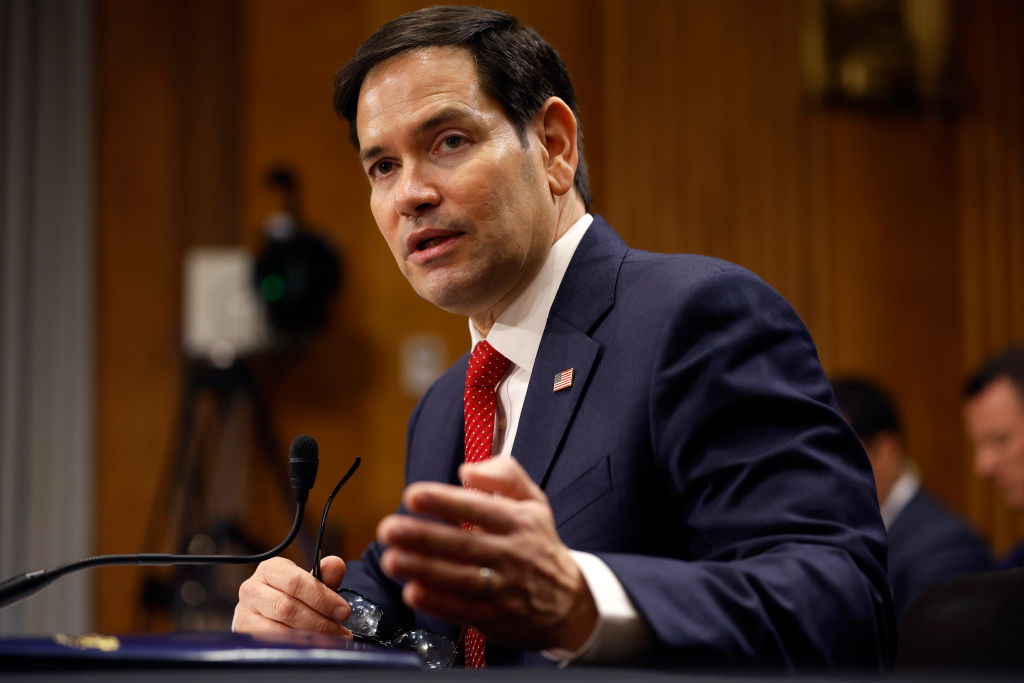
U.S. Secretary of State Marco Rubio said on Tuesday that negotiating a deal with Iran could “take a few days”, quashing hopes for an imminent end to the conflict after U.S. forces conducted what Washington called defensive strikes in southern Iran.
Iran’s Revolutionary Guards said they reserved the right to retaliate against any ceasefire violations, while Iran’s Supreme Leader Mojtaba Khamenei said countries in the region could no longer be a shield for U.S. bases.
Both sides had indicated progress on a memorandum of understanding that could halt the war and restart shipping through the blockaded Strait of Hormuz, while giving negotiators 60 days to negotiate more complex issues including Iran’s nuclear programme.
Referring to the strikes against targets including boats attempting to lay mines and missile launch sites, Rubio told reporters on his plane in India’s Jaipur that the Strait of Hormuz has to be open “one way or the other”.
The war, which began with U.S. and Israeli strikes on Iran on February 28, has caused an unprecedented oil supply shock, pushing up oil prices along with the costs of fuel, fertiliser and food. Iran responded to the strikes by launching drones and missiles at Gulf states that host U.S. bases.
Only a few dozen vessels have been passing through the Strait of Hormuz compared with 125 to 140 daily previously. About a fifth of the world’s oil and liquefied natural gas usually flows through the waterway.
Iran has been letting some ships through, giving preference to ships linked to countries with which it has alliances or close ties, and striking government-to-government agreements, Reuters has reported.
‘CLOCK CANNOT BE TURNED BACK’
Despite a ceasefire in place since early April, U.S. Central Command said in a statement on Monday it had carried out fresh strikes designed “to protect our troops from threats posed by Iranian forces.”
Iran said on Monday it had downed a “hostile” stealth drone using a new air defence system, without saying where it had come from.
The Revolutionary Guards said air defence units had also fired at another drone and at a fighter jet which they said had entered Iranian airspace over the Gulf region.
In comments posted on his Telegram channel on the occasion of the annual hajj pilgrimage, Iran’s Supreme Leader said: “The clock cannot be turned back, and the nations and lands of the region will no longer be a shield for American bases.”
“From now on, the slogans ‘Death to America’ and ‘Death to Israel’ will be the slogans of the Islamic nation and the oppressed people of the world, especially the youth,” he added.
U.S. President Donald Trump has previously cited the slogans while justifying military action against Iran. Trump had said talks with Iran were going “nicely” in a lengthy post on Truth Social on Monday, but warned of fresh attacks if they failed. It “will only be a Great Deal for all, or no Deal at all,” he wrote.
ABRAHAM ACCORDS PUSH
Trump also called on more Arab and Muslim states including Saudi Arabia to sign up to the Abraham Accords, brokered during his first term in office and aimed at normalising ties between those states and Israel.
Saudi Arabia’s longstanding position has been that it would not sign the accords unless there is an agreement on a roadmap to Palestinian statehood.
In another indication of the region’s tensions, Israeli Prime Minister Benjamin Netanyahu said on Monday Israel would intensify strikes against the Iran-backed Hezbollah militia in Lebanon.
Israel’s military soon thereafter said it was attacking Hezbollah infrastructure in Lebanon’s eastern Bekaa Valley and other areas.
Israel and Lebanon agreed to a ceasefire in mid-April, but Israel has continued airstrikes it says are acts of self-defence against Hezbollah, which was not party to the truce.
DOHA TALKS
The U.S. attacks came as Iran’s top negotiator and its foreign minister were in Doha for talks with Qatar’s prime minister on a potential deal to end the war, an official briefed on the visit said.
The official told Reuters the discussions focused on the Strait of Hormuz and Iran’s stockpile of highly enriched uranium, while Iran’s central bank governor attended to discuss the potential release of frozen Iranian funds as part of a final deal.
Iranian foreign ministry spokesperson Esmaeil Baghaei said earlier that nuclear issues would only be negotiated after a memorandum of understanding, or initial deal, was agreed.
According to Iranian sources, the initial deal is only about ending the war on all fronts, establishing a 30-day framework for movement through the Strait of Hormuz, and possibly providing some financial relief – with more complex issues such as Iran’s nuclear programme to be negotiated in a second phase.
Trump has said his key aim in the war is to prevent Iran from developing a nuclear weapon with its highly enriched uranium. Tehran has consistently denied it has plans to do that.
In early Asian trade on Tuesday, U.S. West Texas Intermediate crude was up slightly from Monday’s last traded price but down 5.5% from Friday’s close.
(Reuters)


