







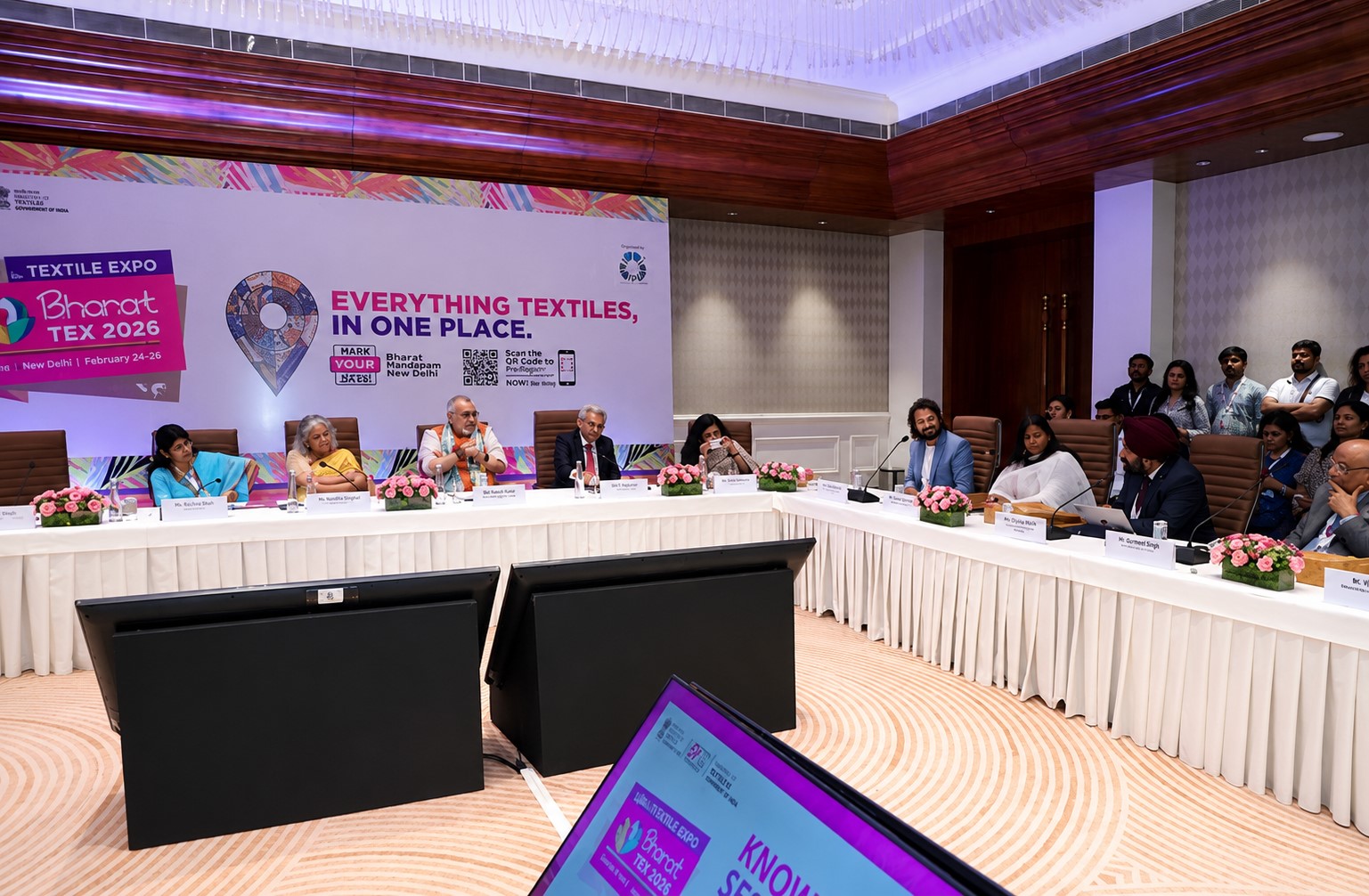
The second day of Bharat Tex 2026 focused on state-led industrial growth, investment promotion and India’s expanding global textile trade partnerships, with discussions highlighting manufacturing, Free Trade Agreements (FTAs) and opportunities across the textile value chain.
The four-day event, being held from July 14 to 17, brought together state governments, policymakers, industry leaders and global trade experts to explore ways to strengthen India’s textile and apparel sector and enhance its global competitiveness.
Union Textiles minister Giriraj Singh, along with Textiles Secretary Neelam Shami Rao, participated in the day’s engagements and interacted with stakeholders at the event.
States showcase textile strengths
A key highlight was the Uttar Pradesh State Session, where the state government presented its expanding textile ecosystem and investment potential in manufacturing, apparel, handloom and handicrafts.
The session was attended by Uttar Pradesh Handloom and Textiles minister Rakesh Sachan and minister of Stamp and Court Fee and Registration Ravindra Jaiswal.
The Karnataka State Session showcased the state’s strengths in textiles and apparel, highlighting its industrial base and opportunities for companies looking to expand manufacturing and sourcing operations.
Meanwhile, the Government of Maharashtra organised a session titled “Maharashtra: An Attractive Global Destination for Technical Textiles in India.” Maharashtra Textiles minister Sanjay Savkare outlined the state’s potential in technical textiles and emphasised its growing role as a hub for technology-driven manufacturing and investment.
The discussions also highlighted the increasing importance of specialised and high-performance textiles in India’s industrial growth.
Focus on global trade, FTAs
Global trade and Free Trade Agreements featured prominently during the day’s programme.
A session titled “Scaling Through Synergy: Building Local Capability to Power Global Textile Value Chains,” organised by ITMF and ASSOCHAM, discussed ways to strengthen domestic manufacturing capabilities and integrate Indian enterprises more effectively into global textile value chains.
Another roundtable, “India’s FTA Moment: Gateway for Textile Value Chains, Market Access and Sourcing Decisions,” organised by Deloitte, examined how India’s FTAs could open new opportunities for textile manufacturers, exporters and sourcing companies through improved market access and stronger value-chain integration.
Leading fashion designers Rahul Mishra and Vaishali Shadangule also participated in a discussion titled “Global Ambitions: Redefining Retail Growth Beyond Borders,” focusing on strengthening Brand India in international markets.
The National Institute of Fashion Technology (NIFT) also hosted a fireside conversation on “Building Global Fashion Enterprises from India: Innovation, Sustainability and Scale.”
India–UK CETA and sustainable supply chains
A ministerial discussion on “India–UK CETA in Action: Shaping the Future of Textile Trade and Investment,” organised by Deloitte, explored the opportunities emerging from the India–UK Comprehensive Economic and Trade Agreement (CETA) and its potential to boost textile trade, investment and business partnerships between India and the United Kingdom.
Another session by Heartland Industries, “Beyond China: Building Tariff-Safe, Compliant & Traceable Hemp Supply Chains for Global Markets,” focused on the importance of diversified, compliant and traceable supply chains to help Indian businesses serve global markets more effectively.
Sustainability awards
The CITI Textile Sustainability Awards 2026 were also presented during the event, recognising excellence in seven areas — resource efficiency, energy and emissions, circular economy, sustainable materials, social responsibility, responsible business and industry collaboration.
Day 3 to feature Madhya Pradesh Chief Minister
The organisers said Madhya Pradesh Chief Minister Dr Mohan Yadav will visit Bharat Tex 2026 on Friday, where he is scheduled to interact with exhibitors, encourage entrepreneurs and visit the Madhya Pradesh Pavilion.
The second day of Bharat Tex 2026 underscored the role of state governments in developing competitive textile ecosystems while leveraging global trade opportunities. The event continued to serve as a platform bringing together governments, industry leaders, manufacturers, exporters, buyers and international partners to strengthen India’s position in the global textile industry.


