







India’s nuclear energy programme is entering an important phase of technological expansion, with the country combining indigenous reactor technologies, a closed nuclear fuel cycle and its vast thorium reserves to build a more secure, sustainable and self-reliant energy future.
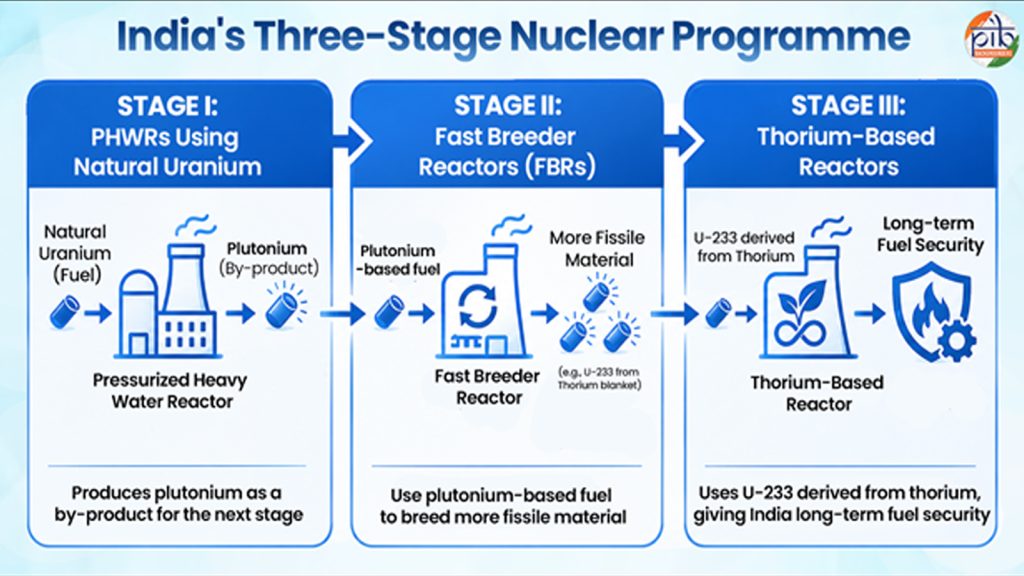
At the heart of the strategy is the three-stage nuclear power programme, conceived by Dr Homi J. Bhabha in 1954 to maximise India’s indigenous resources and reduce dependence on external sources. The programme is designed to progressively move from natural uranium-based reactors to plutonium-fuelled fast breeder reactors and ultimately to thorium-based reactors using uranium-233.
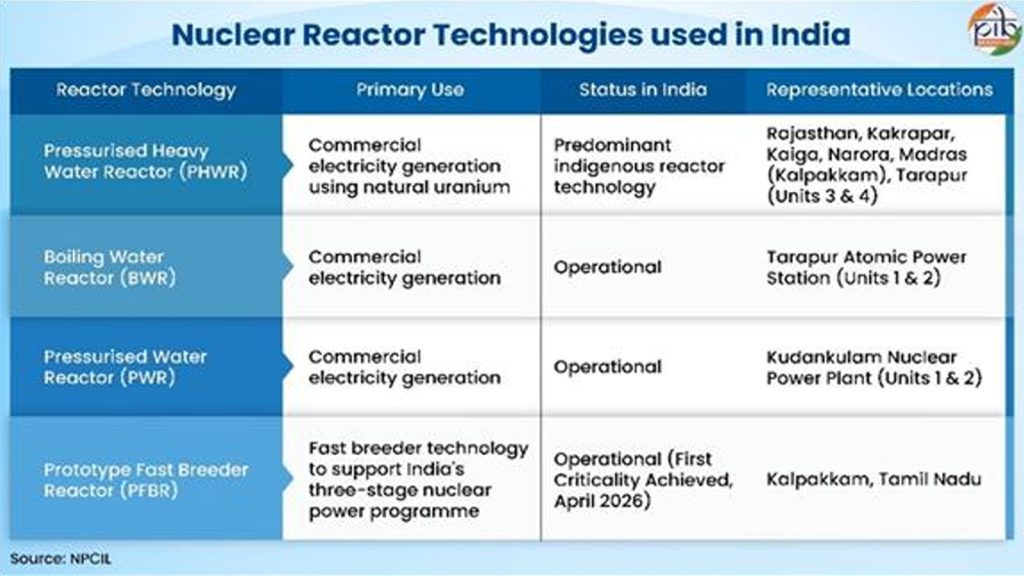
The approach has gained fresh momentum with the Prototype Fast Breeder Reactor (PFBR) at Kalpakkam attaining first criticality in April 2026, marking a major milestone in the second stage of the programme.
India currently operates 24 nuclear power reactors with a combined installed capacity of 8.78 GW. Another nine reactor units, totalling 7.5 GW, are under construction, while the government has approved 10 indigenous Pressurised Heavy Water Reactors (PHWRs) in fleet mode and pre-project activities for two 500 MW Fast Breeder Reactors (FBRs).
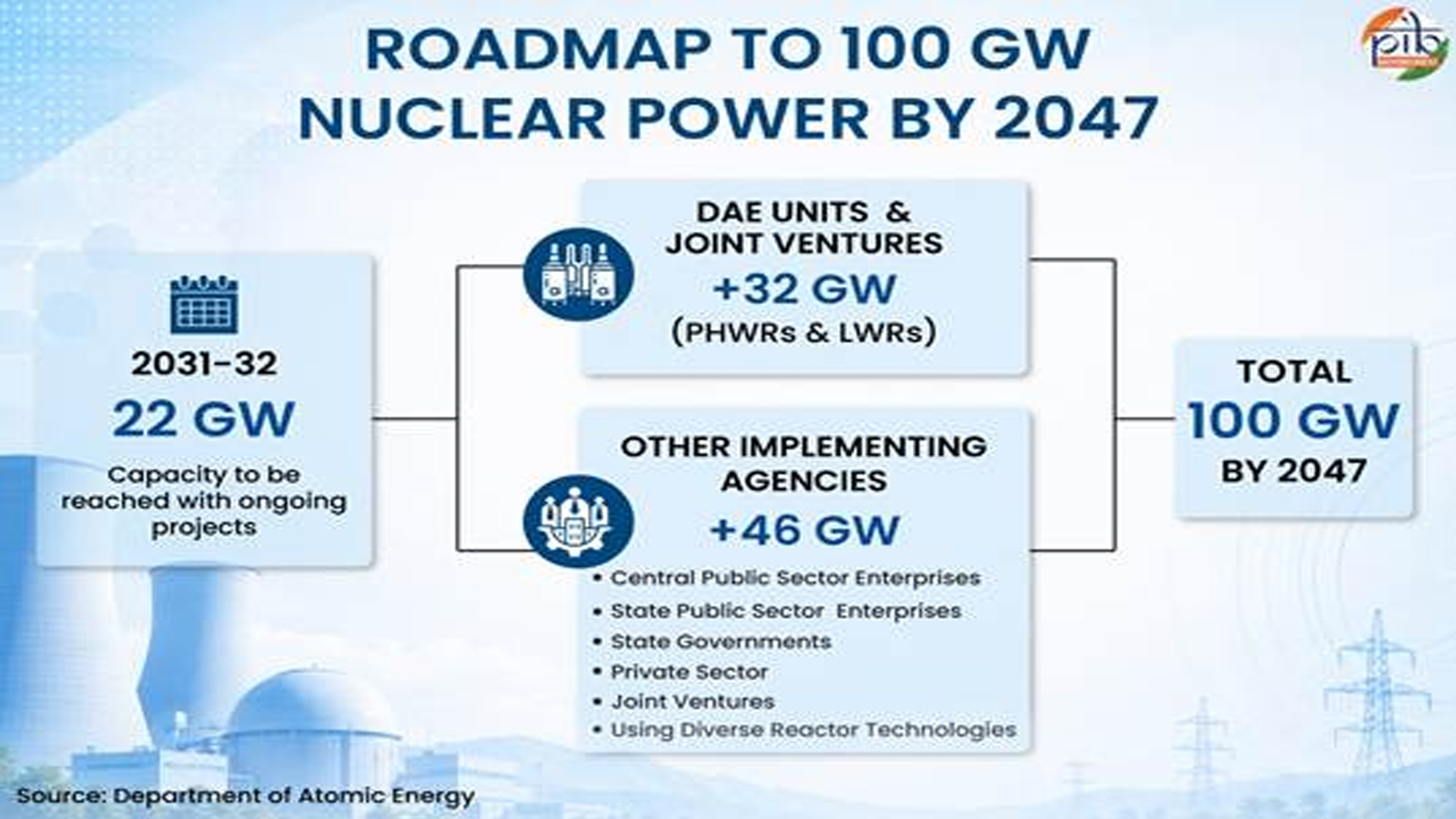
Through the Nuclear Energy Mission announced in 2025-26 and the SHANTI Act, 2025, India is seeking to accelerate nuclear capacity expansion, strengthen domestic manufacturing, promote innovation and enable greater private-sector participation. Nuclear Energy Mission aims to reach 100 gigawatts (GW) of nuclear power capacity by 2047 to support clean energy goals.
The Sustainable Harnessing and Advancement of Nuclear Energy (SHANTI) Act, 2025 came into effect on December 21, 2025, to overhaul the country’s civilian nuclear energy sector.
Nuclear power as the backbone of reliable clean electricity
The government’s nuclear strategy is based on the growing need for clean, reliable and stable baseload electricity.
Baseload power refers to the minimum uninterrupted electricity required to keep an electricity grid functioning. It provides the backbone for essential services such as hospitals, communication networks, defence establishments and industries, while supporting economic growth, national security and disaster resilience.
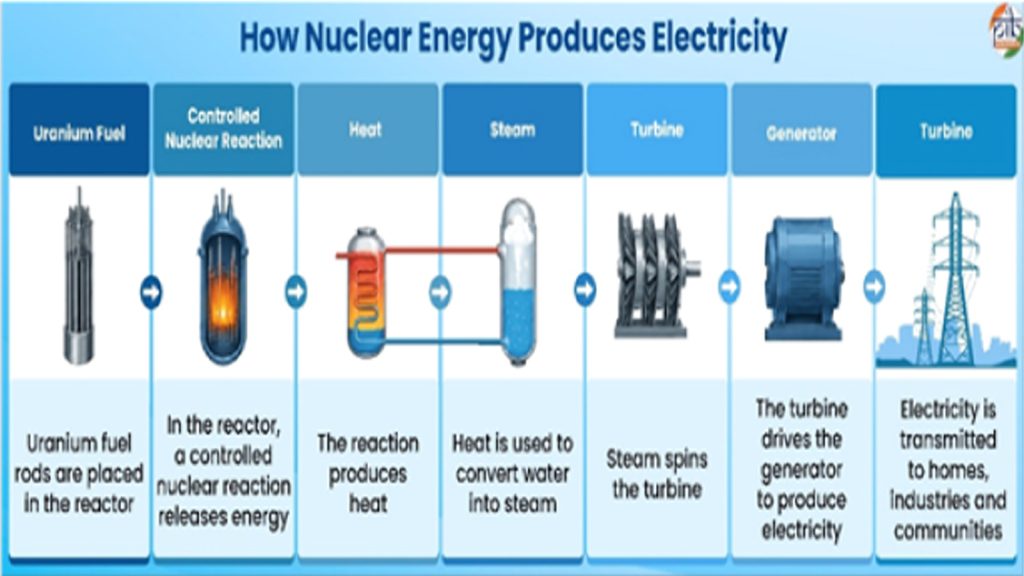
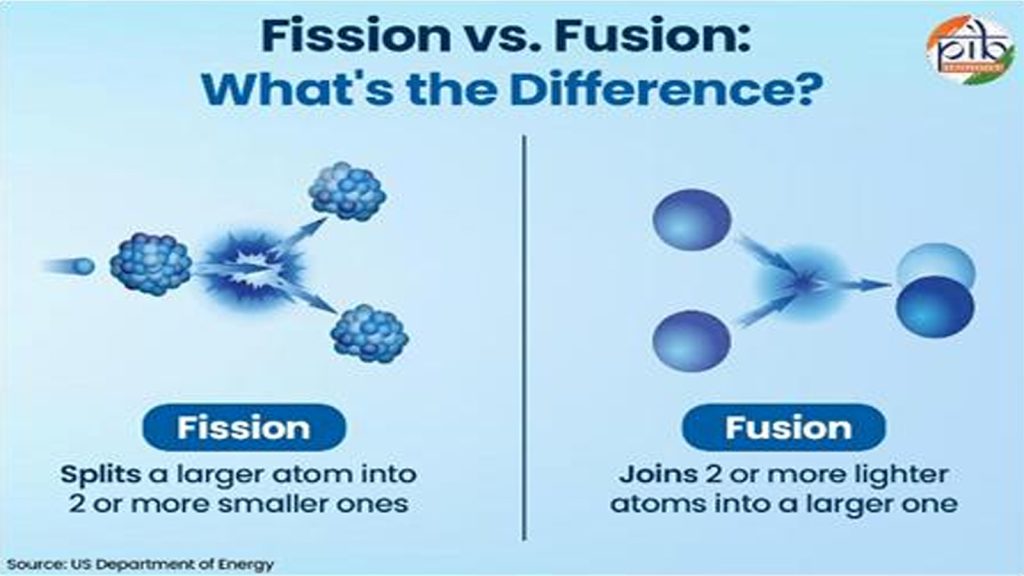
Nuclear power plants generate electricity through a controlled process of nuclear fission. Inside a reactor, atoms of nuclear fuel split and release heat. That heat converts water into steam, which drives a turbine connected to a generator, producing electricity for homes, industries and essential services.
The entire process takes place within multiple engineered safety barriers and under a robust regulatory framework.
Nuclear power also complements renewable energy by providing round-the-clock electricity and supporting grid stability. At the same time, greater use of nuclear power can reduce dependence on imported fossil fuels and contribute to India’s climate commitments.
Building self-reliance across the nuclear fuel cycle
A central feature of India’s nuclear strategy is technological self-reliance.
The country is developing indigenous capabilities across the nuclear fuel cycle, including reactor design, fuel fabrication, waste management and advanced nuclear technologies. This strategy has its roots in the country’s experience of historical fuel embargoes and the need to build a nuclear ecosystem capable of relying increasingly on domestic expertise and resources.
India’s nuclear fuel strategy is particularly distinctive because of its substantial thorium reserves.
India’s uranium reserves are relatively low grade and therefore need to be supplemented through imports. In contrast, the country possesses abundant deposits of thorium-232 (Th-232), particularly in the coastal sands of Kerala, Tamil Nadu, Andhra Pradesh, Odisha and West Bengal, as well as in Jharkhand.
Thorium-232 is a fertile material rather than a fissile fuel. Inside a reactor, it can absorb a neutron and transform into uranium-233, which is fissile and can sustain a nuclear chain reaction.
India’s long-term nuclear strategy therefore seeks to unlock these thorium resources through its three-stage programme.
How India’s three-stage nuclear programme works
The three-stage programme was designed to make maximum use of India’s indigenous uranium and thorium resources.
In the first stage, India’s Pressurised Heavy Water Reactors use natural uranium to generate electricity. Spent fuel from these reactors is reprocessed to recover plutonium, which becomes the primary input for the second stage.
The second stage uses Fast Breeder Reactors. These reactors use plutonium to generate electricity while producing additional fissile material. They can also produce uranium-233 from thorium, laying the foundation for the final stage.
The third stage will use thorium-based reactors and uranium-233 to harness India’s extensive thorium resources.
Thus, each stage is designed to feed the next, gradually expanding the country’s ability to use indigenous nuclear resources and strengthening long-term energy security.
The achievement of first criticality at the PFBR in Kalpakkam in April 2026 marked the beginning of the second stage of this programme.
The Indira Gandhi Centre for Atomic Research (IGCAR) led the design, development, testing, safety assessment, commissioning and indigenisation of the PFBR. Through close cooperation with Indian industry, nearly 90 per cent of the reactor’s equipment and systems were manufactured domestically, strengthening India’s capabilities in advanced nuclear technology.
Understanding the nuclear fuel behind the process
Nuclear fuel is the material placed inside a reactor to generate heat through fission. Nuclear fuels can be fissile, meaning they can directly sustain a chain reaction, or fertile, meaning they can be converted into fissile material inside a reactor.
Common nuclear fuels include natural uranium, uranium-235, low-enriched uranium, plutonium-239 and mixed oxide, or MOX, fuel.
While several major nuclear power countries, including the United States, France, China, Japan, South Korea, Canada and Russia, use low-enriched uranium in Light Water Reactors, India primarily uses natural uranium in its PHWRs, which do not require uranium enrichment.
India also uses MOX fuel in its Prototype Fast Breeder Reactor.
The combination of natural uranium-based PHWRs, plutonium-fuelled fast breeder technology and the eventual utilisation of thorium forms the technological foundation of India’s long-term nuclear strategy.
From conventional reactors to Small Modular Reactors
India is also diversifying its reactor technology.
The country primarily uses Pressurised Heavy Water Reactors, while it also operates Boiling Water Reactors (BWRs) and Pressurised Water Reactors (PWRs).
At the same time, India is advancing Fast Breeder Reactors to utilise plutonium and support the transition towards thorium-based reactors.
Another major area of focus is Small Modular Reactor (SMR) technology.
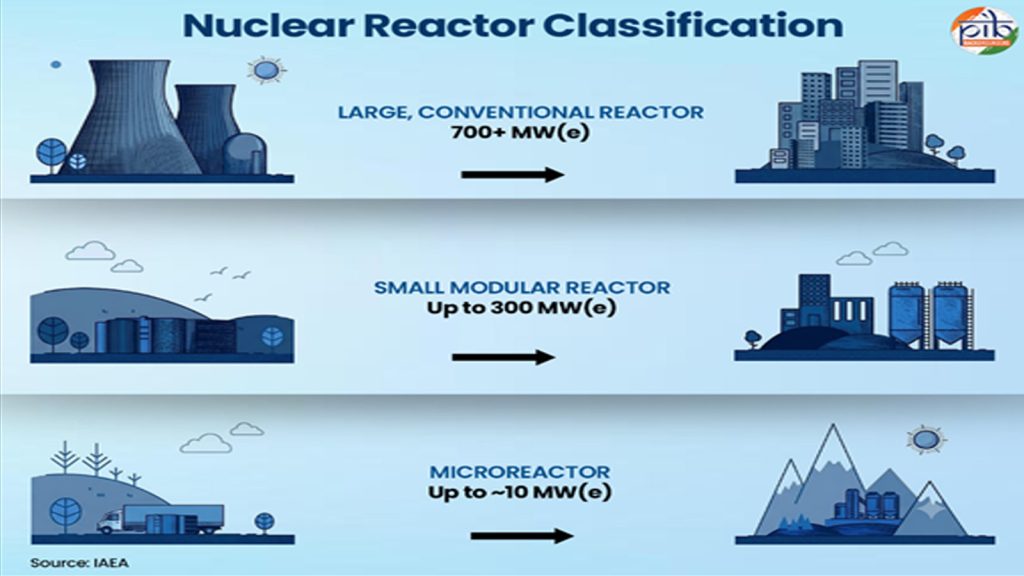
SMRs typically generate up to 300 MWe and use compact, modular designs that can facilitate factory-based manufacturing, faster construction, improved quality control and phased deployment.
Under the Nuclear Energy Mission announced in the Union Budget 2025-26, the government allocated ₹20,000 crore for the research, design, development and deployment of indigenous SMRs.
India is developing the 220 MWe Bharat Small Modular Reactor (BSMR-200), jointly designed by BARC and NPCIL, as well as the 55 MWe SMR-55 and a High-Temperature Gas-Cooled Reactor intended for hydrogen production.
The government aims to operationalise at least five indigenous SMRs by 2033.
Nuclear reactors for different energy needs
India’s nuclear reactor strategy covers a range of applications and power requirements.
Large conventional reactors in the 700-1,600 MW range are designed to provide continuous baseload electricity to national grids, cities and industries.
SMRs of up to 300 MW and Micro Reactors of up to 20 MW can serve more specialised needs. These include supplying power to remote areas, replacing retiring coal plants, providing industrial process heat and supporting hydrogen production.
This modular approach is intended to make nuclear technology more adaptable to India’s diverse energy requirements.
Managing nuclear waste through a closed fuel cycle
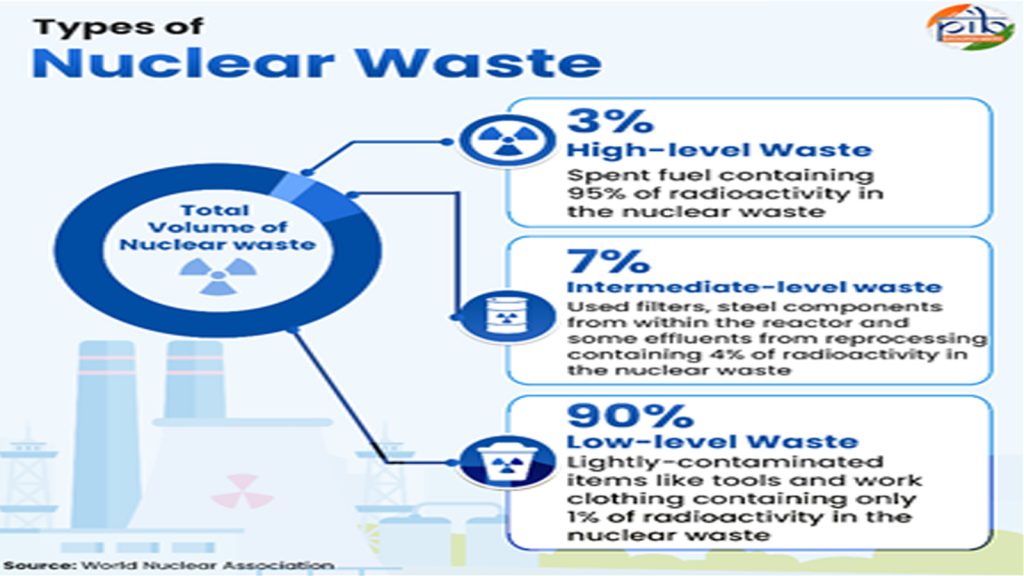
Nuclear power generation also produces radioactive waste, including used nuclear fuel and materials such as protective clothing, filters, tools and equipment that become radioactive during plant operations.
India follows a closed nuclear fuel cycle, in which spent nuclear fuel is reprocessed to recover valuable materials for reuse in future reactors.
The remaining high-level radioactive waste is immobilised and safely stored. This approach reduces waste while also supporting the country’s three-stage nuclear programme by recovering materials that can be used in subsequent stages.
India is also among the few countries possessing vitrification technology for high-level radioactive waste.
Through vitrification, high-level radioactive waste is converted into a stable glass form, making it safer for long-term storage, transportation and eventual disposal.
Indigenous technology at the core
The development of indigenous capabilities is central to India’s nuclear energy ambitions.
From reactor design and manufacturing to fuel utilisation and waste management, the programme seeks to create capabilities across the nuclear value chain.
The PFBR’s nearly 90 per cent domestic manufacturing demonstrates the growing role of Indian industry in advanced nuclear technology. The development of indigenous SMRs is expected to further broaden domestic capabilities and create new avenues for technological innovation and industrial participation.
The SHANTI Act, 2025 and Nuclear Energy Mission are intended to reinforce this ecosystem by accelerating capacity expansion, strengthening domestic manufacturing and encouraging innovation and greater private-sector participation.
Nuclear energy and the road to Viksit Bharat
India’s nuclear energy programme represents a long-term effort to combine energy security, technological self-reliance and sustainability.
With nuclear power providing stable baseload electricity, the technology can complement renewable energy while supporting the country’s expanding electricity requirements. It can also help reduce dependence on imported fossil fuels and contribute to climate goals.
At the same time, India’s three-stage programme offers a distinctive pathway for eventually making greater use of its abundant thorium resources.
The PFBR milestone in 2026, ongoing construction of nine reactors, approval of 10 indigenous PHWRs, preparations for additional Fast Breeder Reactors and the development of indigenous SMRs together point to a broader expansion of India’s nuclear capabilities.
As India advances towards Viksit Bharat, the nuclear programme is therefore being positioned not simply as a source of electricity, but as a comprehensive technological ecosystem. Its combination of indigenous innovation, advanced reactor designs, a closed fuel cycle and long-term thorium utilisation is aimed at creating a secure, sustainable and self-reliant energy future, with the ultimate goal of 100 GW of nuclear power capacity by 2047.


