







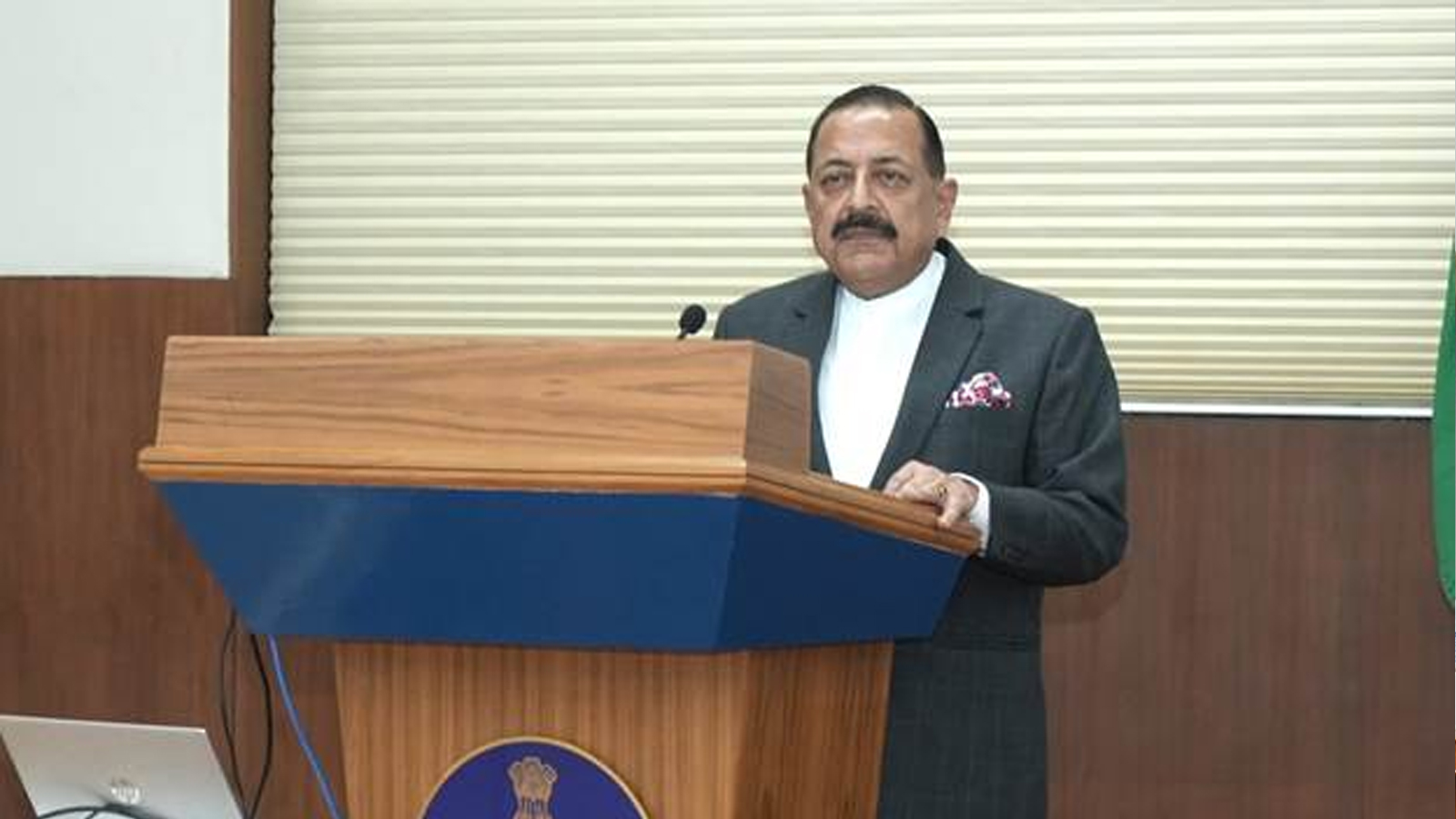
Union Minister of State (Independent Charge) for Science and Technology Dr. Jitendra Singh on Friday said India’s diversity extends beyond its society to its governance systems, making continuous learning, exchange of best practices and adaptive leadership essential for building the next generation of public administration.
Addressing the valedictory session of the 21st Round of the Phase-IV Mid-Career Training Programme (MCTP) for Indian Administrative Service (IAS) officers at the Lal Bahadur Shastri National Academy of Administration (LBSNAA), Mussoorie, the minister said governance in India must evolve by drawing upon the diverse administrative experiences of states and adopting innovative, citizen-centric approaches.
He stressed that the country’s next phase of governance requires continuous learning, young leadership, institutional innovation and reforms focused on improving public service delivery.
“Every state has distinct administrative realities, developmental priorities and governance challenges. Sharing successful practices across cadres will transform India’s diversity into a source of administrative strength,” Singh said.
The four-week programme, held from June 15 to July 10 under Mission Karmayogi, brought together 51 IAS officers with over 14 years of administrative experience from different state cadres for advanced capacity building. LBSNAA Director Sriram Taranikanti, senior faculty members and distinguished resource persons also attended the event.
Departing from the conventional format of delivering a lecture, Singh chose to engage directly with the officers, saying that experienced civil servants possess valuable insights that should help shape future governance reforms and civil services training.
He said training programmes should increasingly become platforms for mutual learning, where participants contribute as much as they learn.
Highlighting the diversity of governance challenges across India, the minister noted that differences in geography, culture, language, political context and developmental priorities have prompted states to develop innovative administrative solutions suited to local needs. Greater interaction among officers from different cadres, he said, would enable these best practices to be adapted across the country.
Referring to Mission Karmayogi, Singh said the initiative has transformed civil services capacity building by shifting the focus from rule-based administration to role-based governance. He added that the iGOT Karmayogi platform has institutionalised continuous learning by enabling government officials to regularly upgrade their knowledge and skills to meet evolving governance challenges.
The minister highlighted several governance reforms introduced over the past decade, including Direct Benefit Transfer (DBT), the Unified Payments Interface (UPI), Digital Public Infrastructure, the JAM Trinity and the Centralised Public Grievance Redress and Monitoring System (CPGRAMS). He said these initiatives have improved transparency, efficiency and service delivery, while DBT has helped prevent leakages and generated savings exceeding ₹3.4 lakh crore.
Singh also said India has emerged as a global leader in frontier technologies through initiatives such as the National Quantum Mission, expansion of the startup ecosystem, opening the space sector to private participation and reforms in the nuclear sector.
He noted that the relationship between the government and the private sector has evolved from regulation to collaboration, enabling innovation-led growth and creating new opportunities for entrepreneurship.
Emphasising that technology must be complemented by compassion, the minister said governance reforms are meaningful only when they improve citizens’ lives. He cited recent personnel reforms, including greater flexibility in family pension nominations, extended maternity-related benefits in cases of stillbirth and revised pension provisions for dependents of government employees, as examples of a more humane and citizen-centric governance approach.
Calling for modernisation of civil services training, Singh advocated greater institutional collaboration, wider faculty diversity and curricula that keep pace with technological and societal changes. He also encouraged greater participation of younger serving officers as faculty members, noting that officials working in districts and ministries often possess the most relevant practical experience.
The minister highlighted the growing importance of effective communication in public administration, saying district officers today must engage confidently with citizens, the media and elected representatives while maintaining transparency and accountability.
He also called for a less hierarchical administrative culture, arguing that learning should never be constrained by seniority. “Practical ideas and innovations often emerge from officers working closest to implementation. The willingness to keep learning throughout one’s career remains one of the defining qualities of effective leadership,” he said.
Concluding his address, Singh expressed confidence that officers completing the programme would strengthen inter-state learning, promote innovative and citizen-centric governance, and contribute to India’s vision of becoming a developed nation by 2047 through continuous learning and adaptive leadership.


