







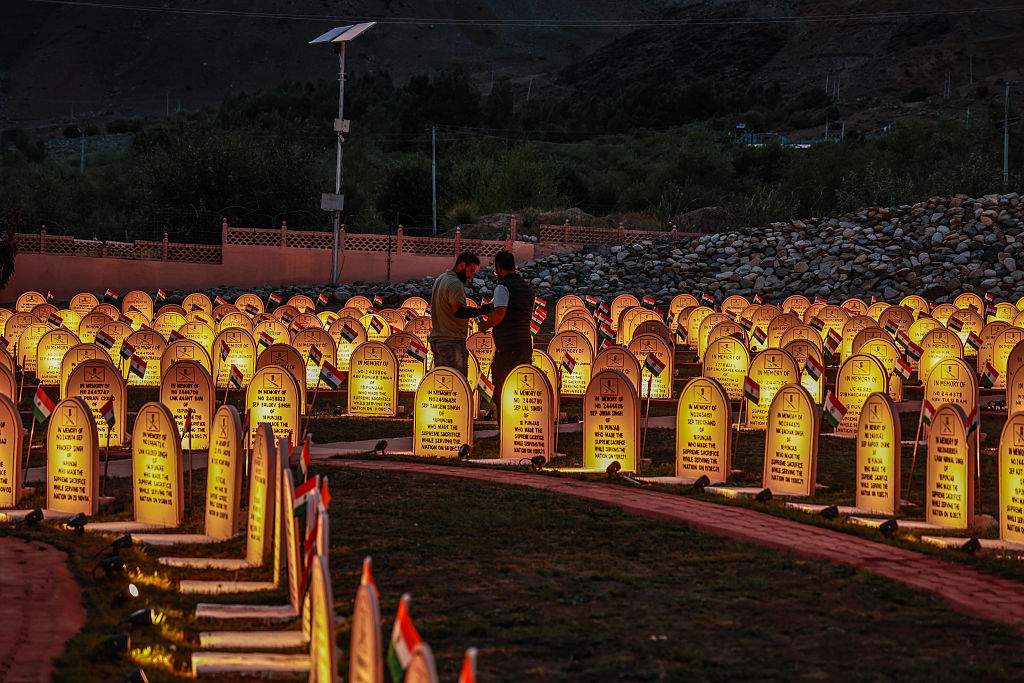
Every year on July 26, India commemorates Kargil Vijay Diwas, paying tribute to the courage, sacrifice and unwavering resolve of the soldiers who laid down their lives during the 1999 Kargil War. The day marks the successful culmination of Operation Vijay, through which the Indian Armed Forces reclaimed strategic mountain peaks occupied by Pakistani intruders along the Line of Control (LoC) in the Kargil sector of Ladakh.
Twenty-seven years later, Kargil Vijay Diwas remains more than a remembrance of military victory. It symbolises India’s commitment to safeguarding its sovereignty, honours the extraordinary valour of its Armed Forces and reflects the far-reaching defence reforms and military modernisation undertaken since the conflict.
Operation Vijay: The Battle for the Heights
The Kargil conflict began in May 1999, when Pakistani soldiers and armed intruders crossed the Line of Control and occupied strategic heights overlooking the Srinagar-Leh National Highway. Their objective was to disrupt India’s logistical link with Ladakh and alter the status quo along the LoC.
After local residents reported suspicious activity, reconnaissance missions confirmed the extent of the intrusion. In response, India launched Operation Vijay, while the Indian Air Force initiated Operation Safed Sagar to provide aerial support. The Indian Navy simultaneously enhanced its operational deployment, demonstrating coordinated action across all three services.
The campaign witnessed intense fighting in some of the world’s most challenging terrain. Indian soldiers scaled near-vertical cliffs under enemy fire, battling freezing temperatures, high altitudes and rugged mountain conditions to reclaim every occupied position.
Turning Points in the War
Several key battles shaped the outcome of the conflict.
The recapture of Tololing on June 13, 1999, marked the first major breakthrough, paving the way for further advances. The successful assault on Tiger Hill on July 4, 1999, became one of the defining moments of the war, significantly shifting the momentum in India’s favour. Fierce operations also took place in Batalik, Mushkoh Valley, Kaksar, and Point 4875, culminating in the complete restoration of Indian positions by the end of July.
On July 14, 1999, then Prime Minister Atal Bihari Vajpayee declared Operation Vijay a success, and on July 26, India formally announced victory after all occupied positions had been recaptured without crossing the Line of Control. The operation earned India international recognition for exercising military restraint while firmly defending its territorial integrity.
Bravery That Became a National Inspiration
Operation Vijay was marked by countless acts of extraordinary courage. Soldiers displayed exceptional determination in some of the harshest battlefield conditions, often engaging in close combat at altitudes exceeding 5,000 metres.
The nation honoured this valour with four Param Vir Chakras, nine Maha Vir Chakras, 55 Vir Chakras and several other gallantry awards. Heroes such as Captain Vikram Batra, Grenadier Yogendra Singh Yadav and Captain Vijyant Thapar continue to inspire generations with their courage and sacrifice.
Kargil’s Lasting Impact on India’s Defence Preparedness
The Kargil War exposed operational and logistical challenges that prompted wide-ranging reforms in India’s defence architecture.
Among the most significant institutional changes were the creation of the Department of Military Affairs and the appointment of the Chief of Defence Staff (CDS) to enhance jointness among the Army, Navy and Air Force. Defence procurement procedures were streamlined, indigenous manufacturing received renewed focus, and greater participation from the private sector was encouraged through liberalised foreign direct investment norms.
India’s defence budget has also grown substantially over the past decade, supporting investments in modern equipment, infrastructure and strategic capabilities. According to the Ministry of Defence, defence production reached a record ₹1.78 lakh crore in 2025–26, while defence exports rose to ₹38,424 crore, with Indian-made equipment now reaching more than 80 countries.
Towards a Future-Ready Military
Since Kargil, India has accelerated the induction of advanced military platforms and emerging technologies across all three services.
Key additions include INS Vikrant, the indigenous aircraft carrier; Arjun Mk IA battle tanks; Rafale fighter aircraft; Apache and Chinook helicopters; the BrahMos supersonic cruise missile; and the Project 17A stealth frigates. The Armed Forces have also integrated drone warfare, enhanced surveillance capabilities and expanded indigenous missile development programmes.
Recent milestones include successful tests of the Kusha Long-Range Surface-to-Air Missile, Long Range Land Attack Cruise Missile, Pinaka Long Range Guided Rocket, advancements in hypersonic technologies, and operational clearance for the indigenous Netra Airborne Early Warning and Control (AEW&C) system, underscoring India’s growing technological capabilities in defence.
An Evolving Security Doctrine
The lessons of Kargil have also shaped India’s response to evolving security challenges.
The 2016 Surgical Strikes, 2019 Balakot Air Strikes and Operation Sindoor in 2025 reflected a more proactive approach to counter-terrorism and demonstrated India’s growing reliance on precision strikes, intelligence-led operations, drones and integrated air defence systems. These developments highlight the evolution of India’s military doctrine from defensive deterrence to calibrated and technology-driven responses.
Honouring the Bravehearts
Kargil Vijay Diwas is marked across the country through commemorative events honouring the soldiers of Operation Vijay.
This year’s observances include the Shaurya Vijay Yatra, the Wheels of Valour: Sanchar Shakti motorcycle expedition, the Tiger Hill Expedition, tributes by veterans at the Kargil War Memorial and Khalubar War Memorial, commemorative treks to Point 5140, and military equipment displays showcasing the capabilities of the Indian Armed Forces.
A Legacy That Endures
Twenty-seven years after the Kargil War, the victory continues to inspire the nation. It stands as a testament to the courage of India’s soldiers, the resilience of its Armed Forces and the country’s unwavering commitment to protecting its sovereignty.


