







India’s space sector is entering a transformative phase as years of policy reforms and institutional support begin to reshape the country’s space ecosystem. The launch of Vikram-1, India’s first privately developed orbital launch vehicle by Skyroot Aerospace, became a defining milestone in this journey, reflecting the growing role of private enterprise in a sector that was once dominated by government-led missions.
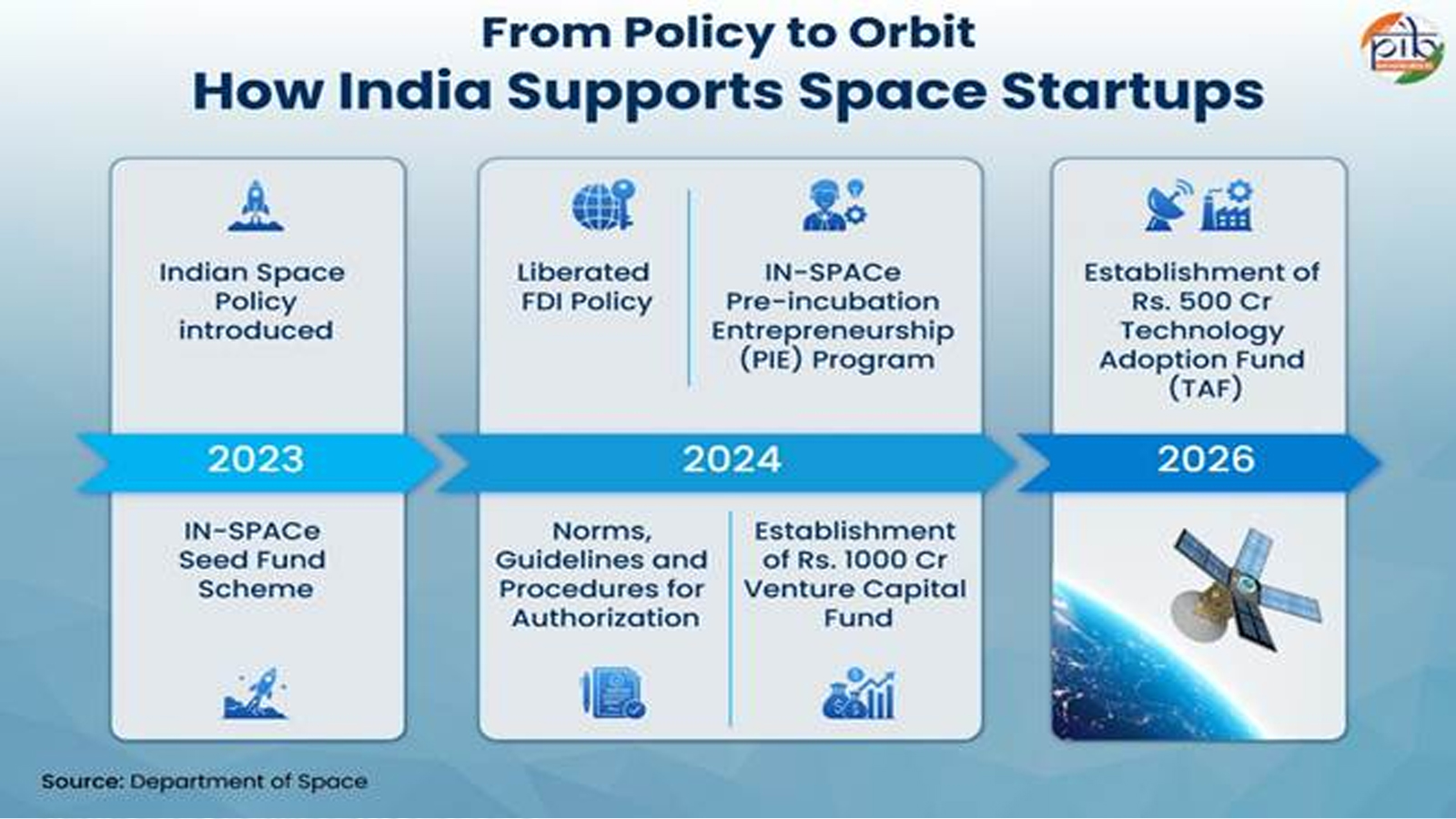
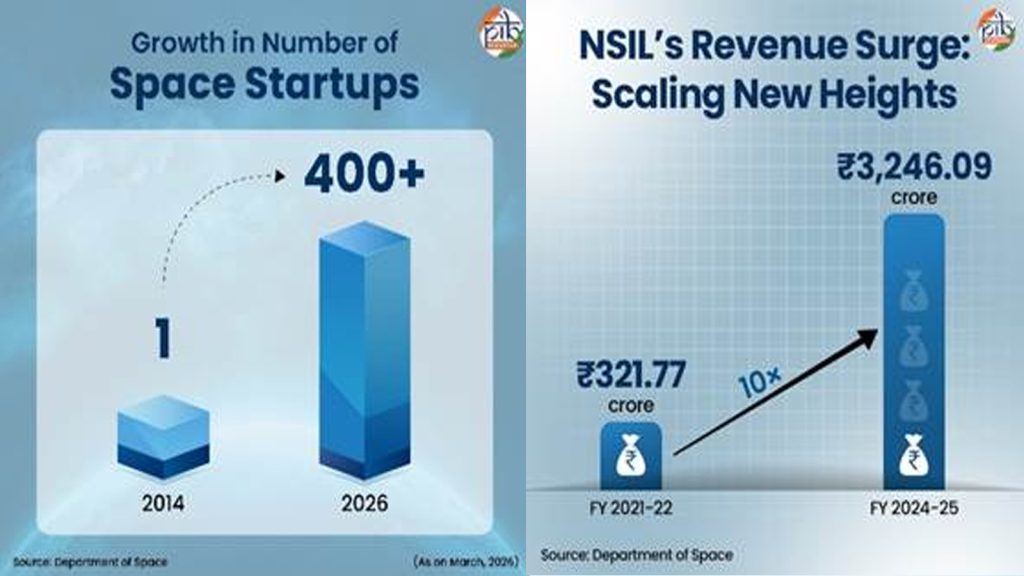
The launch comes against the backdrop of the Government of India’s sweeping reforms, particularly the Indian Space Policy 2023, which opened the entire space value chain to private participation. The policy has enabled non-government entities to engage in satellite manufacturing, launch services, space applications and downstream services, creating new opportunities for innovation, investment and commercial activity. As a result, India’s private space ecosystem has expanded rapidly, with the number of space startups increasing from just one in 2014 to more than 400 in 2026.
The sector’s economic potential is also growing steadily. India’s space economy, currently valued at approximately USD 8.4 billion, is projected to expand five-fold to between USD 40 billion and USD 45 billion by 2030, with a long-term target of reaching USD 100 billion by 2040. Government support, enabling regulations and stronger public-private partnerships are driving this growth, positioning India as an emerging global hub for space technology, manufacturing, innovation and commercial space activities.
At the centre of this new chapter is Mission Aagaman, under which Vikram-1 was launched on July 18. Developed by Skyroot Aerospace, the launch vehicle is capable of placing a 350-kilogram payload into Low Earth Orbit. Built using an all-carbon composite structure, reliable solid-fuel boosters and a 3D-printed liquid engine, Vikram-1 represents a significant technological achievement for India’s private space industry.
The mission deployed multiple customer payloads into a 450-kilometre Low Earth Orbit. These include Skyroot’s SCOPE satellite, DCUBED’s technology demonstration payload, Grahaa Space’s SOLARAS S3 satellite and Cosmoserve Space’s Embrace, a robotic arm designed to capture orbital debris. Alongside these payloads, the mission carried two symbolic artefacts – a floral-shaped artwork titled “Cosmic Bloom” and an 18-karat gold micro-rocket featuring microscopic sculptures of scientists C. V. Raman, Vikram Sarabhai and A. P. J. Abdul Kalam, honouring India’s scientific pioneers.
The launch validated India’s indigenous commercial launch capability while demonstrating the impact of the government’s policy reforms on the country’s expanding private space sector.
A key institution driving these reforms is the Indian National Space Promotion and Authorisation Centre (IN-SPACe), which functions as an autonomous single-window agency for authorising and promoting space activities by both government organisations and non-government entities. Strengthened under the Indian Space Policy 2023, IN-SPACe provides a stable regulatory framework, facilitates access to ISRO facilities and expertise, and streamlines approvals through transparent guidelines.
As of June 2026, IN-SPACe had registered more than 4,500 organisations, issued 133 authorisations and signed 106 Memoranda of Understanding. The organisation has also played a major role in attracting investment and strengthening industry collaboration. By February 2026, it had facilitated USD 150 million in investments into Indian space startups during calendar year 2025, while the top ten startups secured confirmed order books of the same value. By June 2026, IN-SPACe had facilitated 118 technology transfer agreements and signed 189 Joint Project Implementation Plans, Technology Partnership Agreements and Business Partnership Agreements.
To further strengthen the private ecosystem, the government has introduced multiple funding mechanisms. The IN-SPACe Seed Fund Scheme provides grants of up to ₹1 crore to eligible startups and micro and small enterprises developing innovative space technologies and applications, while also offering mentorship, training and networking support. The scheme also supports startups working on agriculture, disaster management and urban development solutions based on space technology.
The government has also established a ₹1,000 crore Venture Capital Fund under IN-SPACe to accelerate private participation in the space sector. The fund, which will be deployed over five years from FY 2025-26 to FY 2029-30, is designed to provide early-stage capital to promising startups while attracting additional private investment. Annual investments under the fund are expected to range between ₹100 crore and ₹250 crore.
Complementing this initiative is the ₹500 crore Technology Adoption Fund, which supports the commercial deployment of indigenous space technologies developed by non-government entities. The scheme provides funding of up to 60 per cent of project costs for startups and MSMEs and up to 40 per cent for large industries, subject to a maximum of ₹25 crore per project.
Commercialisation has also become a central pillar of India’s evolving space programme. Under the Indian Space Policy 2023, NewSpace India Limited (NSIL) has been designated as ISRO’s commercial arm, responsible for manufacturing and procuring space systems on commercial principles while delivering end-to-end space solutions to both government organisations and private entities. NSIL also supports satellite services, markets space products and spin-off technologies, and promotes private participation through PSLV productionisation and small satellite technology transfer.
The commercial expansion is reflected in NSIL’s performance. The organisation has recorded a tenfold increase in revenue over the years. As of December 2025, more than 70 Technology Transfer Agreements had enabled ISRO-developed technologies to be commercialised by industry. By July 2026, NSIL had launched 141 satellites, including 138 international or customer satellites and three Indian satellites, reinforcing India’s reputation as a reliable global launch service provider.
The government has also liberalised the Foreign Direct Investment policy for the space sector to encourage greater international investment. The revised framework allows up to 74 per cent automatic FDI in satellite manufacturing and operations, 49 per cent automatic FDI in launch vehicles and spaceports, and 100 per cent automatic FDI in the manufacturing of satellite components and subsystems. The reforms are expected to accelerate investment, promote technology transfer and strengthen collaborative research while improving ease of doing business.
The impact of these reforms is already visible across the sector. NSIL executed India’s first dedicated commercial LVM3 mission in October 2022, launching 36 OneWeb satellites into Low Earth Orbit. In November 2022, Vikram-S became India’s first privately developed rocket and the country’s first private launch authorised by IN-SPACe, successfully demonstrating critical technologies for future orbital missions.
Another milestone followed in May 2024 when Agnikul Cosmos became the first non-government entity to launch a rocket from India’s first private launch pad, ‘Dhanush’, at Sriharikota, while also demonstrating the world’s first single-piece 3D-printed semi-cryogenic rocket engine.
Private participation has expanded beyond launch vehicles. IN-SPACe approved a public-private partnership for an Earth Observation satellite constellation led by Pixxel, in collaboration with Dhruva Space, SatSure Analytics India and Piersight Space, to strengthen applications in agriculture, disaster management, climate monitoring and urban planning.
Technology commercialisation has also gained momentum. In February 2026, IN-SPACe facilitated the ₹511 crore, ten-year transfer of Small Satellite Launch Vehicle technology to Hindustan Aeronautics Limited, enabling industry-led production and launch services. Bellatrix Aerospace also successfully demonstrated an indigenous Green Propulsion System under DRDO’s Technology Development Fund, strengthening India’s capabilities in cleaner propulsion technologies.
With the launch of Vikram-1 under Mission Aagaman, India’s space sector entered a new phase where government policy, private innovation and commercial enterprise work together to shape the country’s future in space. The evolving ecosystem, supported by sustained reforms, targeted funding and stronger industry participation, is positioning India to emerge as a leading global space power and an increasingly significant player in the future space economy.


