







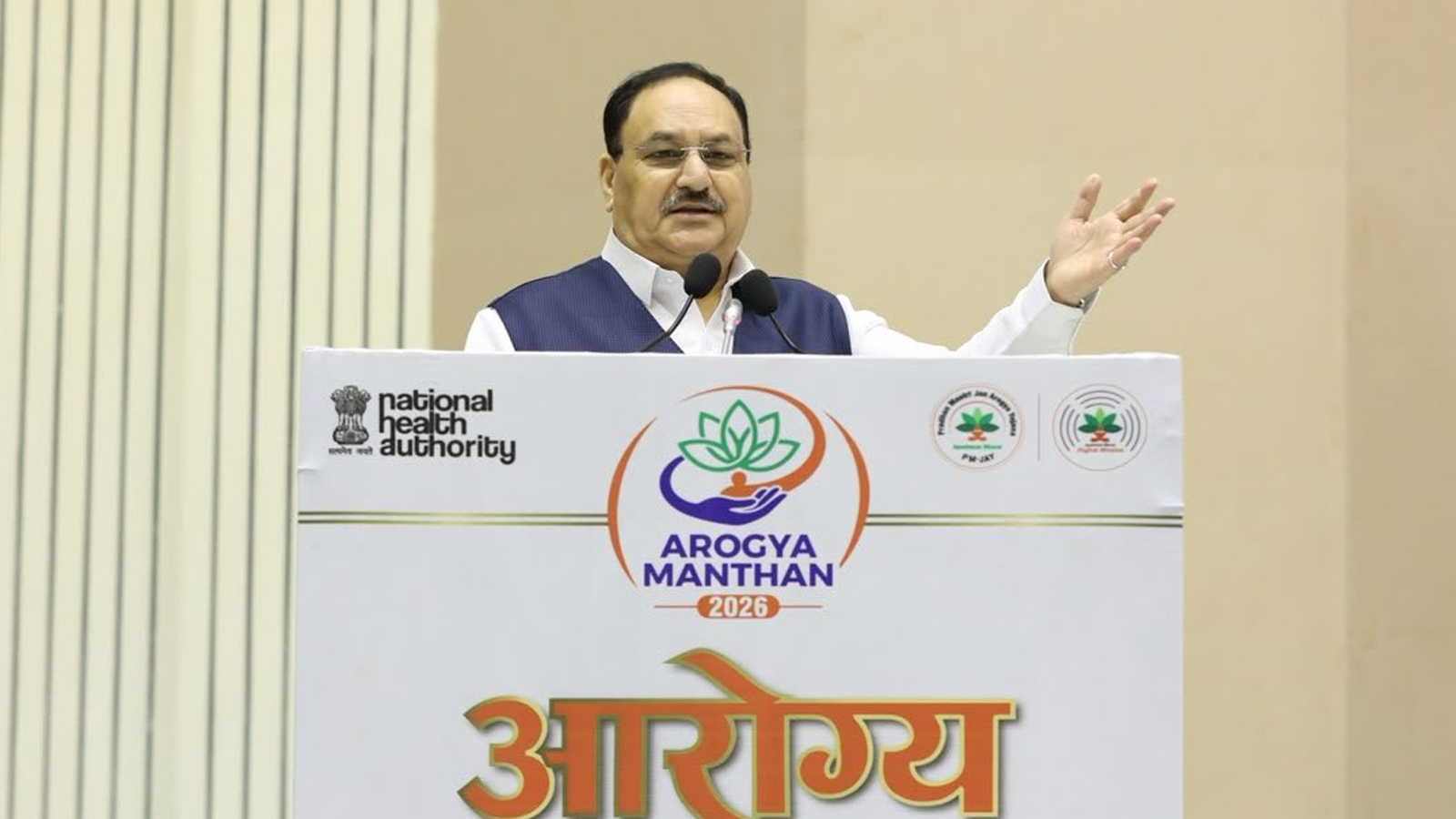
Union Health and Family Welfare Minister J.P. Nadda on Friday inaugurated Arogya Manthan 2026 at Vigyan Bhawan, New Delhi, marking eight years of Ayushman Bharat Pradhan Mantri Jan Arogya Yojana (AB PM-JAY) and five years of the Ayushman Bharat Digital Mission (ABDM).
Organised by the National Health Authority (NHA), the event brought together government officials, healthcare providers, insurers, technology and digital health experts, academics, development partners and other stakeholders to review India’s health assurance and digital health ecosystem and discuss priorities for its next phase.
Nadda said the milestones of AB PM-JAY and ABDM provided an opportunity to assess the progress made and renew the commitment towards the welfare of poor and marginalised sections of society, in line with Prime Minister Narendra Modi’s vision of “Sabka Saath, Sabka Vikas, Sabka Vishwas, Sabka Prayas.”
PM-JAY Covers Over 60 Crore Beneficiaries
Highlighting the expansion of AB PM-JAY since its launch, Nadda said the scheme has emerged as the world’s largest health assurance programme, covering more than 60 crore beneficiaries and facilitating over 13 crore hospital admissions, involving treatment worth more than ₹2 lakh crore.
He also highlighted the expansion of the scheme to cover all senior citizens aged 70 years and above, irrespective of their socio-economic status.
Nadda emphasised the importance of portability under AB PM-JAY, particularly for migrant workers, and acknowledged the contribution of state governments, healthcare institutions and other stakeholders in implementing the programme.
ABDM Expands Digital Health Infrastructure
The Health Minister said the journey of AB PM-JAY and ABDM demonstrated the transformative role of technology in healthcare, particularly in authentication, authorisation and access to treatment across locations.
Under ABDM, more than 97.8 crore ABHA IDs have been created, with over 121 crore health records linked. More than 5.6 lakh health facilities and around 11 lakh healthcare professionals are registered on the ABDM ecosystem.
He also highlighted the development of the National Health Claims Exchange (NHCX), which seeks to bring hospitals and insurers onto a common digital platform.
Nadda said the initiatives launched during Arogya Manthan 2026 would strengthen digital healthcare, facilitate secure use of health data and create new opportunities for health research, innovation and data-driven decision-making.
New Digital Health Initiatives Launched
A major highlight of the event was the launch of several initiatives aimed at strengthening India’s digital health and health assurance infrastructure. These include:
* National Healthcare Providers Registry (NHPR) Mobile App
* NHCX Implementation Guide for Payers
* Guidebook for a Model Digital Health Facility
* Secure Data Environment (SDE) application
* Framework for Auto-Adjudication of Claims under AB PM-JAY
The Secure Data Environment, developed by NHA with support from the Indian Institute of Science (IISc), Bengaluru, is designed as a governed environment for accessing and analysing AB PM-JAY and ABDM health data.
Approved entities will be able to work with de-identified data or execute code within an isolated NHA environment, with outputs reviewed before release. The initiative is intended to support health research, programme planning, outcome analysis and responsible artificial intelligence innovation while incorporating safeguards for personal data protection.
The Auto-Adjudication Framework is aimed at streamlining and strengthening the claims adjudication process under AB PM-JAY through technology and data-driven processes.
Focus on Quality, Interoperability and Health Insurance
The deliberations at Arogya Manthan 2026 focused on improving the efficiency, quality and interoperability of health services.
A session on “NHCX for Streamlining Health Insurance” examined the role of the claims exchange in creating standardised and technology-driven insurance processes. Other sessions discussed intelligent claims processing, strategic purchasing, quality and cost-effectiveness of healthcare, digital platforms for improving access and the use of common health-data standards.
Dr. M. Srinivas, Member (Health), NITI Aayog, highlighted the need to strengthen continuity of care, quality and patient-centric healthcare, including seamless referral mechanisms for patients requiring specialised treatment.
He also stressed wider adoption of ABHA, interoperability of digital health records and the use of high-quality, standardised health data for research and responsible application of artificial intelligence.
IRDAI Chairman Ajay Seth highlighted the need for greater standardisation and transparency in health insurance. He underlined the importance of ABHA as an identity for health insurance, treatment codification, standard billing formats and standard treatment protocols and guidelines.
ICMR Highlights Standardised Treatment and Cost-Effectiveness
Dr. Rajiv Bahl, Director General, ICMR and Secretary, Department of Health Research, said the next phase of Ayushman Bharat should focus on improving healthcare quality and expanding coverage.
He highlighted collaboration between DHR, ICMR and NHA in two areas – standardisation of treatment and cost-effectiveness.
According to Bahl, ICMR has developed more than 150 standard treatment workflows and guidelines. He also highlighted the role of Health Technology Assessment in India (HTAIn) under DHR in evaluating the cost-effectiveness of healthcare technologies and interventions.
NHA Highlights Scale of PM-JAY and ABDM
NHA CEO Sunil Kumar Barnwal highlighted the scale of the two programmes, noting that more than 49 crore Ayushman Cards and around 98 crore ABHA IDs have been generated across the country.
He said AB PM-JAY has generated more than 13 crore patient records, creating a repository that could support research, development and health analytics. The Secure Data Environment would enable responsible use of such data while protecting patient identities, he added.
States and UTs Recognised for Performance
Arogya Manthan 2026 also recognised States and Union Territories for their performance under AB PM-JAY and ABDM across different categories.
Under AB PM-JAY, Andhra Pradesh, Sikkim and Jammu & Kashmir were recognised for the highest card saturation among ASHA, Anganwadi Worker (AWW) and Anganwadi Helper (AWH) beneficiaries in the large State, small State and Union Territory categories, respectively.
Chhattisgarh, Maharashtra and Gujarat were recognised as the top-performing States in claim settlement for inter-State portability.
Under ABDM, Bihar, Ladakh and Dadra and Nagar Haveli were recognised as top-performing States/UTs across model districts based on district population categories.
Chandigarh, Assam and Uttar Pradesh were recognised for the highest number of sub-centres using ABDM-enabled Health Management Information Systems (HMIS) in the small State/UT, medium State/UT and large State categories, respectively.
Nadda expressed confidence that the deliberations at Arogya Manthan 2026 would generate actionable outcomes and further strengthen India’s health ecosystem, making healthcare more accessible, efficient and patient-centric.


