







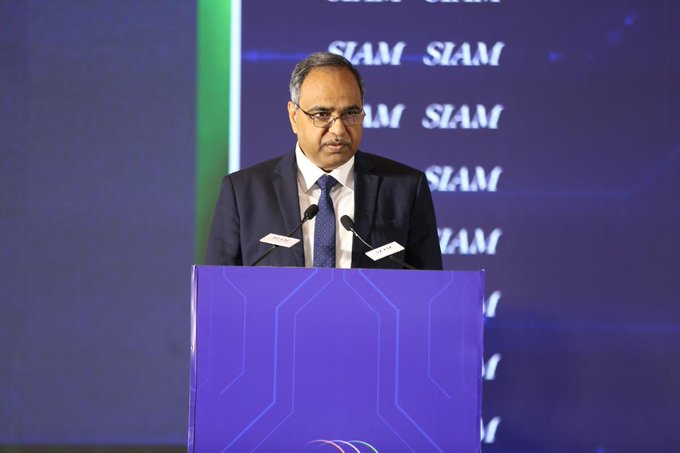
India’s automotive industry continues to be a key driver of economic growth, contributing more than Rs 22.75 lakh crore to the economy and accounting for around 15 per cent of the country’s GST collections, Society of Indian Automobile Manufacturers (SIAM) President Shailesh Chandra said on Thursday.
Addressing the annual convention of SIAM, Chandra said the automobile industry provides direct and indirect employment to more than 30 million people and has a significant multiplier effect across allied sectors and the wider supply chain.
The sector also maintained strong growth across domestic sales and exports in 2025-26, with several vehicle categories recording their highest-ever volumes.
Passenger vehicle sales reached a record 4.6 million units in FY2025-26, registering a 7.9 per cent increase over the previous year. Exports in the segment also touched an all-time high of 0.91 million units, growing 17.5 per cent year-on-year.
Two-wheeler domestic sales rose 10.7 per cent to a record 21.71 million units, while exports increased 23.4 per cent to 5.18 million units.
Three-wheeler domestic sales grew 12.8 per cent to 8.4 lakh units. Exports witnessed a sharper rise, increasing 50.1 per cent from 3.1 lakh units to 4.6 lakh units.
Commercial vehicle sales in the domestic market also reached a record 10.80 lakh units, up 12.6 per cent from the previous year. Exports rose 17.4 per cent to 95,000 units.
Push towards sustainability
Chandra said the industry’s growth has been accompanied by greater alignment with national and global priorities on sustainability, decarbonisation and vehicle safety.
He said the entire automobile industry transitioned to manufacturing fully E20-compliant gasoline vehicles from April 1, 2025.
The shift towards E20-compatible vehicles supports the government’s efforts to reduce dependence on crude oil imports and strengthen India’s energy security, he said. The industry has also witnessed commercial launches and demonstrations of flex-fuel vehicles by several original equipment manufacturers.
EV adoption rises
Electric mobility continued to gain momentum across vehicle categories during FY2025-26, with the share of EVs in new registrations increasing at double-digit levels in passenger vehicles, two-wheelers and three-wheelers.
Total EV registrations in India rose to 2.5 million units in FY2025-26 from 1.97 million units in FY2024-25, marking a 24.7 per cent increase.
Chandra attributed the rising adoption of electric vehicles to continued collaboration between the government and the automobile industry.
He said the Centre’s PM E-DRIVE scheme has provided significant impetus to India’s transition towards electric mobility.


