







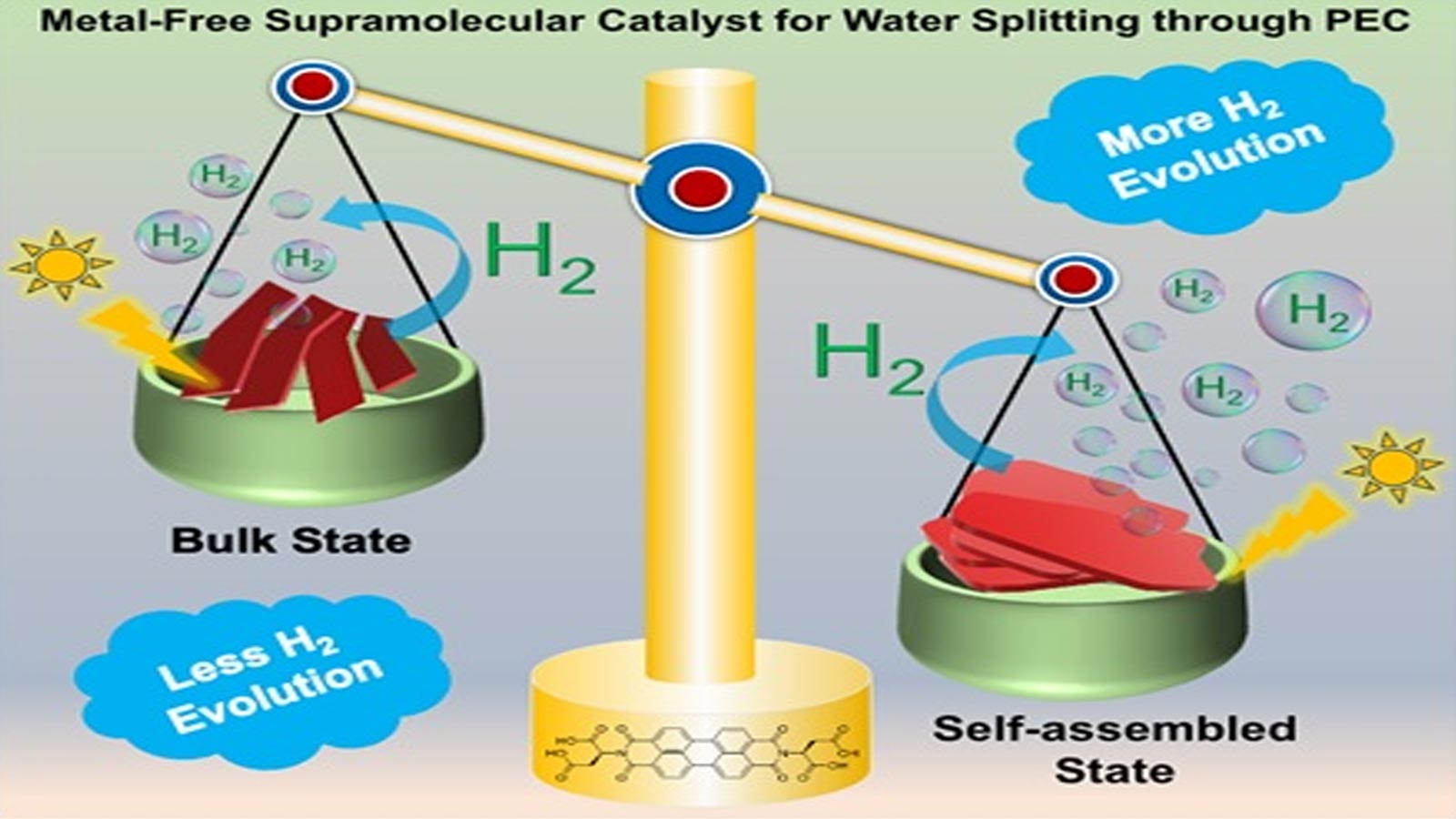
Scientists at the Centre for Nano and Soft Matter Sciences (CeNS), Bengaluru, have developed a metal-free organic material that could improve solar-driven hydrogen production by harnessing the self-assembly of naturally occurring molecules.
The research combines the amino acid aspartic acid with a light-absorbing organic molecule called perylene diimide (PDI). The researchers found that when the two components are integrated, they spontaneously organise themselves into highly ordered two-dimensional nanosheets in water, improving the material’s ability to convert sunlight into chemical energy.
Green hydrogen can be produced by using sunlight to split water into hydrogen and oxygen. However, many existing photocatalysts depend on inorganic semiconductors or precious metals, which can be expensive, difficult to manufacture and raise concerns about long-term sustainability. Developing efficient metal-free organic photocatalysts has therefore emerged as an important research challenge.
The CeNS team, an autonomous institute under the Department of Science and Technology (DST), synthesised an aspartic acid-functionalised PDI molecule that underwent supramolecular self-assembly in water.
According to the researchers, the enhanced performance stems from the way the molecules organise themselves. The aspartic acid component promotes strong and extended hydrogen bonding, while the PDI component facilitates π–π stacking and efficient absorption of light. The interaction between the two determines the molecular arrangement and, consequently, the material’s photocatalytic properties.
The molecular reorganisation significantly broadened light absorption, improved charge separation, reduced energy losses and increased the surface area available for catalytic reactions. As a result, the self-assembled material generated nearly 18 per cent higher photocurrent than its bulk counterpart during solar-driven water splitting.
Advanced electrochemical measurements and density functional theory (DFT) calculations indicated that the self-assembly process enables more efficient charge transport. The researchers also found that the amino acid increases the molecular dipole moment, helping separate photo-generated charges more effectively and supporting hydrogen evolution.
The study demonstrates that naturally occurring amino acids can serve not only as molecular building blocks but also as regulators of supramolecular organisation and photocatalytic performance.
The researchers said the molecular design approach could provide a more sustainable pathway for developing efficient, environmentally friendly and metal-free photocatalysts for solar energy conversion.
The study was led by Dr Goutam Ghosh and Dr Ashutosh K. Singh of CeNS, Bengaluru, along with Sourav Moyra, Kumar Shubham and Athira Chandran M. The findings have been published in the Journal of Materials Chemistry A, a leading journal of the Royal Society of Chemistry.
The researchers said materials based on this approach could have potential applications in future green hydrogen production, artificial photosynthesis, solar fuel generation and next-generation renewable energy devices, potentially reducing dependence on costly and scarce metals.


