







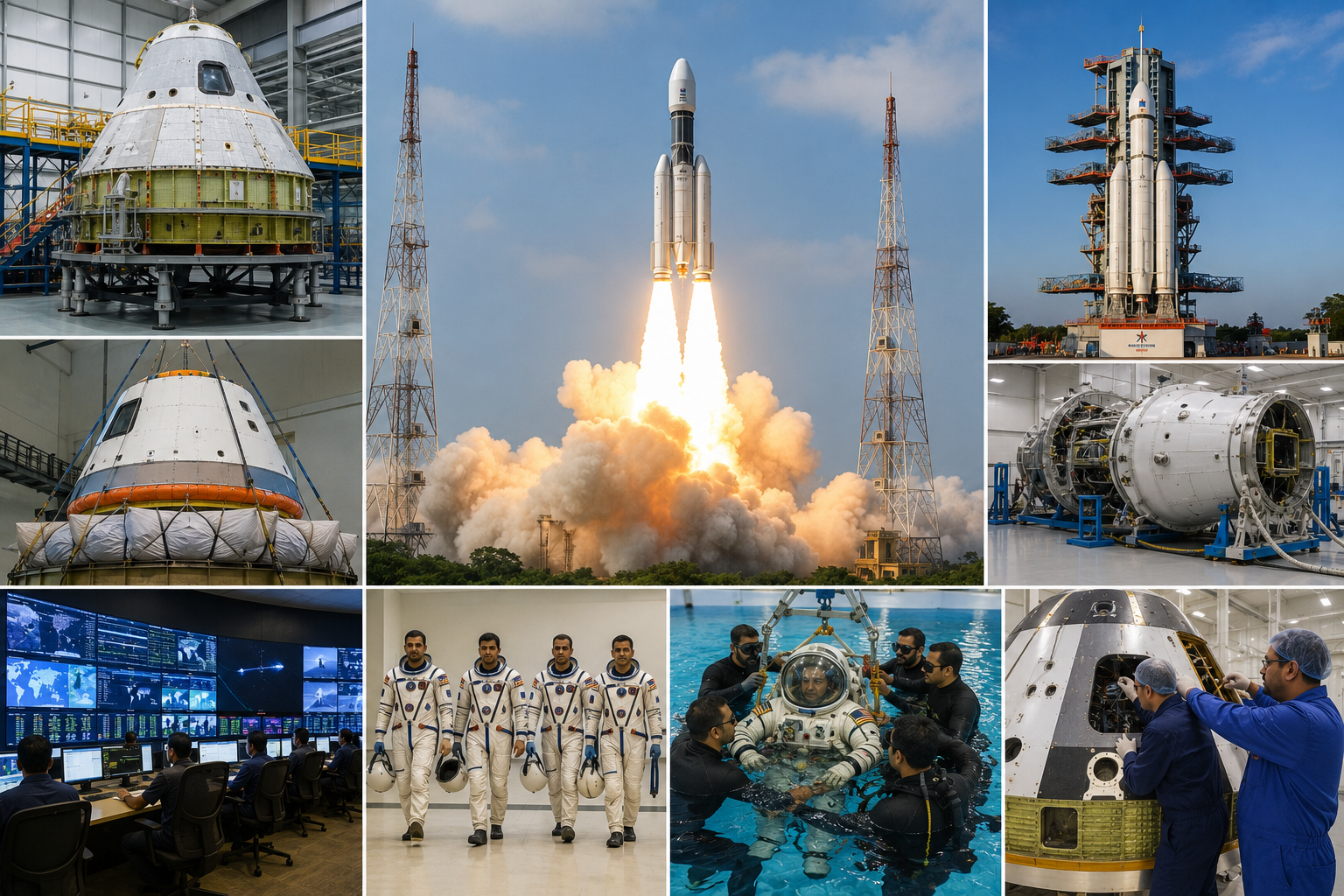
India’s ambitious human spaceflight programme, Gaganyaan, has achieved significant milestones, with critical launch systems, spacecraft components and mission infrastructure either completed or nearing readiness ahead of the first uncrewed mission, the government informed Parliament on Wednesday.
In a written reply to the Lok Sabha, Minister of State in the Prime Minister’s Office, Dr. Jitendra Singh, said preparations for the first uncrewed Gaganyaan mission (G1) are progressing steadily, while the country’s first astronaut mission continues to move through its development and testing phase.
The government said the Human Rated Launch Vehicle (HLVM3) has completed the development and ground testing of all its propulsion stages and structural systems. The vehicle has been specially designed to safely carry astronauts into space.
Significant progress has also been made in the development of the Orbital Module, comprising the Crew Module and Service Module. Propulsion systems for both modules have been developed, tested and qualified, while critical technologies including the Environmental Control and Life Support System (ECLSS) engineering model, thermal protection system, deceleration system, Crew Module uprighting system and end-to-end avionics have also been developed and successfully tested.
The Crew Escape System (CES), designed to safely separate astronauts from the launch vehicle in the event of an emergency, has also reached an advanced stage. Five types of escape motors have been developed and successfully undergone static testing, while all associated structures have been realised and qualified.
The government informed Parliament that several mission-critical facilities have been established, including the Orbital Module Preparation Facility, Gaganyaan Control Centre, Gaganyaan Control Facility, Crew Training Facility, and modifications to the Second Launch Pad at Satish Dhawan Space Centre (SDSC SHAR) to support future crewed missions.
ISRO has also completed several key test campaigns. These include the successful Test Vehicle Demonstration Mission (TV-D1) for in-flight validation of the Crew Escape System, along with Integrated Air Drop Tests (IADT-01 and IADT-02) to validate the Crew Module’s deceleration system. Preparations for the TV-D2 mission are currently in an advanced stage.
According to the government, the Gaganyatris have completed their generic astronaut training at Glavkosmos in Russia, while mission-specific training is currently underway at the Astronaut Training Facility in Bengaluru.
For the upcoming uncrewed G1 mission, all propulsion stages of the HLVM3—HS200, L110 and C32—along with Crew Escape System motors are ready. The Crew Module and Service Module systems have been realised, while assembly, integration and testing are nearing completion. Integrated mission simulations are also being carried out.
The government said Gaganyaan missions will be launched from the Second Launch Pad at SDSC SHAR, which has undergone extensive upgrades to meet human spaceflight requirements. These include modifications to the Second Vehicle Assembly Building, enhanced checkout facilities, a Crew Access Arm, bubble lift, and a zip-line emergency evacuation system to ensure astronaut safety during launch operations.
The Environmental Control and Life Support System (ECLSS), one of the most critical technologies for human spaceflight, is also being developed indigenously by ISRO. The system is designed to maintain a habitable environment inside the Crew Module by regulating temperature, humidity, air pressure and carbon dioxide levels throughout the mission. It is currently undergoing development tests, and a reduced version of the system will be demonstrated during the upcoming uncrewed Gaganyaan missions.


