







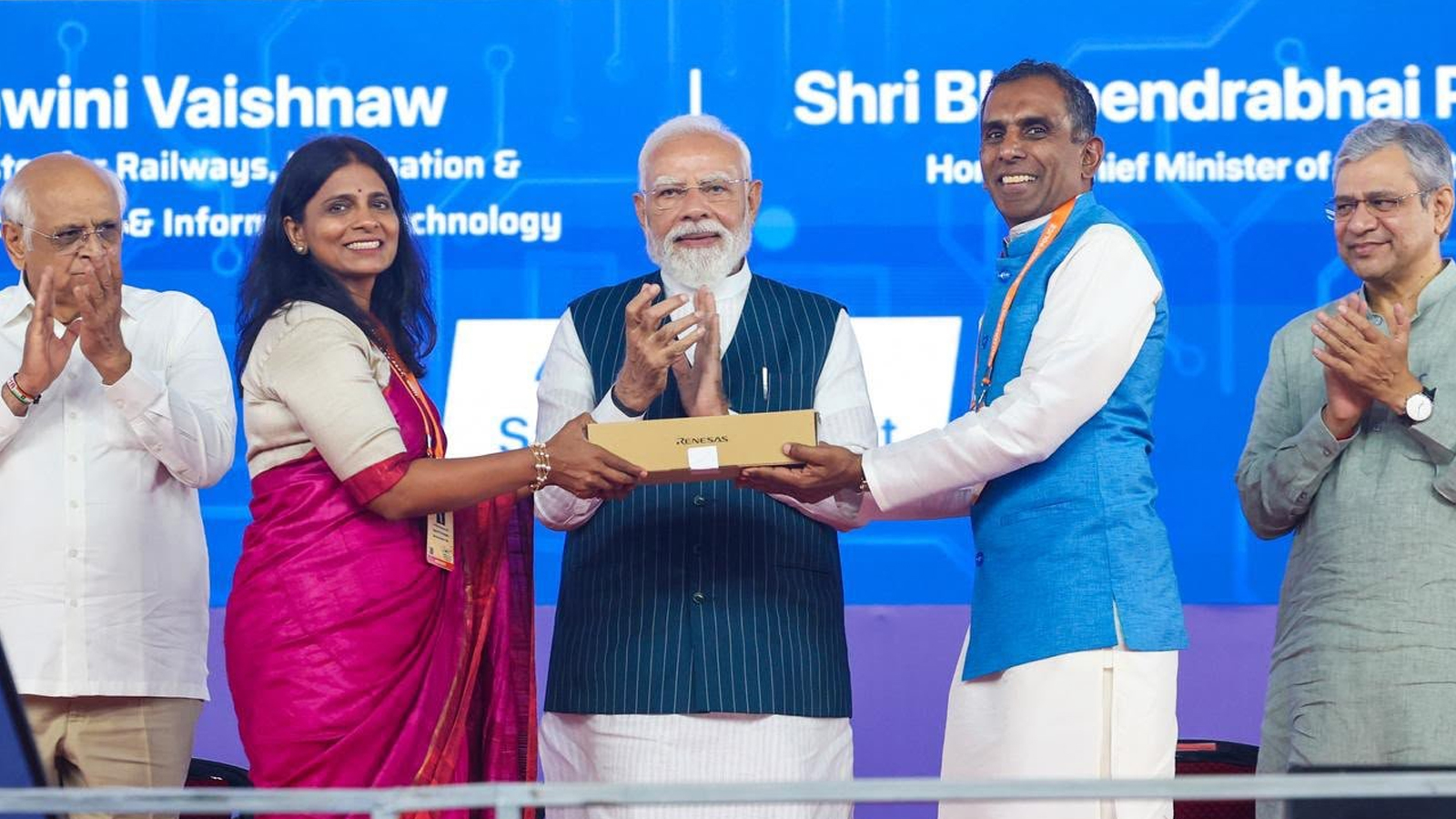
Prime Minister Narendra Modi on Saturday said India’s youth will spearhead the global revolution in artificial intelligence (AI), robotics and next-generation technologies using semiconductors manufactured in the country, as he inaugurated the CG Semi Outsourced Semiconductor Assembly and Test (OSAT) facility in Sanand, Gujarat.
Describing the inauguration as a landmark moment in India’s semiconductor journey, the Prime Minister said the commencement of commercial production at the facility reflects the country’s ability to transform ambitious goals into reality.
“Today’s event is proof that whatever India resolves to do, it firmly accomplishes,” he said, adding that the project represents a significant milestone in the vision of making India a global hub for advanced technology through the twin pillars of “Design in India” and “Make in India.”
The Prime Minister recalled that the foundation stone for the facility was laid in 2024, with chip testing beginning in August 2025, and commercial production now commencing within a short span. He attributed the rapid progress to the dedication of engineers, workers and industry partners involved in the project.
Calling the facility a symbol of international technological collaboration, PM Modi highlighted the partnership between Indian, Japanese and Thai companies, saying it goes beyond a commercial venture and represents a trusted global technology partnership that will strengthen India’s semiconductor ecosystem.
The Prime Minister noted that the facility has already achieved an annual production capacity of 20 crore semiconductor units and expressed confidence that it would soon reach its targeted capacity of 500 crore units annually.
Congratulating the project team, the Gujarat government and industry partners, he said the country’s semiconductor mission is progressing steadily “step by step, brick by brick and chip by chip.”
Emphasising the importance of creating integrated industrial ecosystems, PM Modi referred to globally renowned innovation hubs such as Silicon Valley, Hsinchu Science Park and Tsukuba Science City, saying India’s semiconductor ambitions require similar technology clusters. He said Sanand is rapidly emerging as one such ecosystem with semiconductor manufacturing, testing facilities, design centres and supporting industries developing simultaneously.
The Prime Minister pointed out that companies such as Micron, Kaynes and CG Semi have begun operations in the region within a short period, while additional investments in specialised chemicals, testing laboratories and semiconductor design are expected to create a comprehensive supply chain and generate significant employment opportunities.
He said the growth of India’s semiconductor industry is the result of a decade-long strategy to strengthen domestic electronics manufacturing.
Recalling India’s transformation in mobile phone manufacturing, PM Modi said the country has moved from being heavily dependent on imports to becoming the world’s second-largest producer and exporter of mobile phones. Electronics production has increased nearly seven-fold since 2014, while exports have grown eleven times during the same period.
The Prime Minister said India is now moving beyond manufacturing finished electronic products to producing key components and semiconductors domestically, thereby creating a complete value chain.
He stressed that the next phase of growth would focus on strengthening domestic capabilities in critical minerals, advanced materials, chip design and semiconductor packaging.
“Our youth will power the AI, robotics and next-generation technology revolution with Made-in-India chips,” PM Modi said, expressing confidence that Indian talent would lead future technological breakthroughs.
Highlighting the employment potential of the semiconductor industry, the Prime Minister said the sector will create opportunities across research, design, manufacturing, testing and supply chain management, similar to the growth witnessed during the IT and mobile manufacturing revolutions.
He urged young Indians to continuously upgrade their skills and embrace emerging technologies, particularly AI, to remain globally competitive.
The Prime Minister also shared his interaction with employees at the facility, particularly young women from remote and tribal regions who have undergone specialised semiconductor training, including overseas programmes in Malaysia.
Describing their achievements as inspiring, PM Modi said these young women have become an integral part of India’s advanced semiconductor manufacturing ecosystem.
Reaffirming the government’s commitment to strengthening India’s manufacturing ecosystem, PM Modi said policy stability, ease of doing business and rapid execution of projects would continue to attract investments and accelerate the country’s journey towards becoming a developed nation by 2047.
In a post on X on Sunday, the Prime Minister said, “One of the most special moments during the inauguration of the CG Semi Outsourced Semiconductor Assembly and Test (OSAT) facility in Sanand was the opportunity to interact with the youth who are working there. A large number of the workforce includes women. They hail from remote parts of India, many of them are from tribal backgrounds. But their remarkable spirit ensured that they learnt about semiconductors. They went for training and here they are, adding strength to India’s semiconductor journey. Proud of our Yuva Shakti!”
The CG Semi OSAT facility is one of the first four projects approved under the India Semiconductor Mission and has been developed with an investment of over ₹7,500 crore. Once fully operational, it will have an annual production capacity of up to five billion semiconductor chips, catering to sectors including automotive, telecommunications, industrial electronics, 5G and the Internet of Things (IoT).


