







From a village tailoring shop in Madhya Pradesh to a thriving noodle manufacturing unit in Maharashtra and an award-winning filmmaking venture in Karnataka, stories of determination and entrepreneurship are emerging from rural India through the Rural Self Employment Training Institutes (RSETIs). Operating under the Deendayal Antyodaya Yojana–National Rural Livelihoods Mission (DAY-NRLM), these institutes are helping thousands of rural youth and women build sustainable livelihoods by equipping them with practical skills, entrepreneurship training and access to financial support.
For Vishnu Bai, the journey to self-reliance began with hardship. Born into a modest farming family, her education ended after Class VIII due to an early marriage. Less than two years later, she returned to her parental home as financial difficulties engulfed her marital family. With no financial assistance from her brothers, she began stitching clothes from home, earning a modest income while seeking greater independence.
Her life changed after joining the Shri Ram Self-Help Group, which introduced her to training opportunities at the Rural Self Employment Training Institute in Bhopal. Unable to travel because of social restrictions, she requested that the training be conducted in her village. Responding to her request, the institute organised classes at the Panchayat Bhawan, where women learned tailoring alongside the fundamentals of running a small business.
After completing the programme, Vishnu Bai established a tailoring shop in her village and gradually expanded her work to include men’s garments. A government order to stitch school uniforms provided a steady source of income and enabled her to invest in industrial sewing machines. Over time, her small enterprise evolved into a stable livelihood, demonstrating how practical skills combined with institutional support can transform lives.
Such stories are at the heart of the RSETI initiative, which seeks to promote self-employment and micro-enterprises across rural India. Established through a partnership between the Ministry of Rural Development, State and Union Territory governments, and sponsor banks, RSETIs provide free, short-term, residential and practical training to unemployed rural people between the ages of 18 and 50. Their support extends beyond training by facilitating access to bank credit and offering continued guidance to help trainees establish viable businesses.
The institutes currently offer 73 courses across agriculture, manufacturing, services and entrepreneurship, all aligned with national skill standards. Sponsor banks play a key role by extending financial assistance to trained candidates, ensuring that newly acquired skills translate into sustainable economic opportunities.
Another inspiring example is that of Umesh Shivaji Ingle, whose journey reflects the transformative impact of entrepreneurship training. Coming from a financially constrained family, he completed his education only up to Class X and spent nearly five years working as a daily wage labourer in a noodle factory. Although he worked long hours, his earnings barely met his family’s needs.
Encouraged by a friend, Umesh enrolled in an Entrepreneurship Development Programme at an RSETI, where he combined his factory experience with formal business training. After completing the course, he launched a small noodle manufacturing unit using a second-hand machine and basic equipment. Initially producing around 1,000 to 1,200 kilograms of noodles daily, he gradually expanded his operations as demand increased.
His enterprise now earns a monthly profit of around ₹30,000 and provides employment to four women from vulnerable backgrounds. A bank loan of ₹8 lakh enabled him to shift operations to a larger unit in MIDC Akola, significantly expanding production capacity. His journey from daily wage labourer to entrepreneur and employer reflects the wider social impact of RSETI-supported enterprises.
In Karnataka’s Dharwad district, Sanjay Malagi’s entrepreneurial journey followed a different path. After earning a diploma in electrical engineering, he worked for a multinational company in Bengaluru before returning home in search of more meaningful work. During this period, he enrolled in a photography course at RSETI Dharwad, an experience that ultimately reshaped his career.
Inspired by the training, Sanjay founded Cinewinks in 2019, transforming his passion for storytelling into a professional venture. His work spans videography, editing and film direction across multiple Indian languages, with themes exploring migration, politics and the misuse of technology.
His short film Tamasoma Jyotirgamaya, portraying the struggles of weavers, received two international awards, while Hinnota earned him the Best Director award at the Cochin International Short Film Festival during 2020-21. Over time, he has won nearly ten awards, and his company now undertakes projects across multiple cities while creating employment opportunities locally.
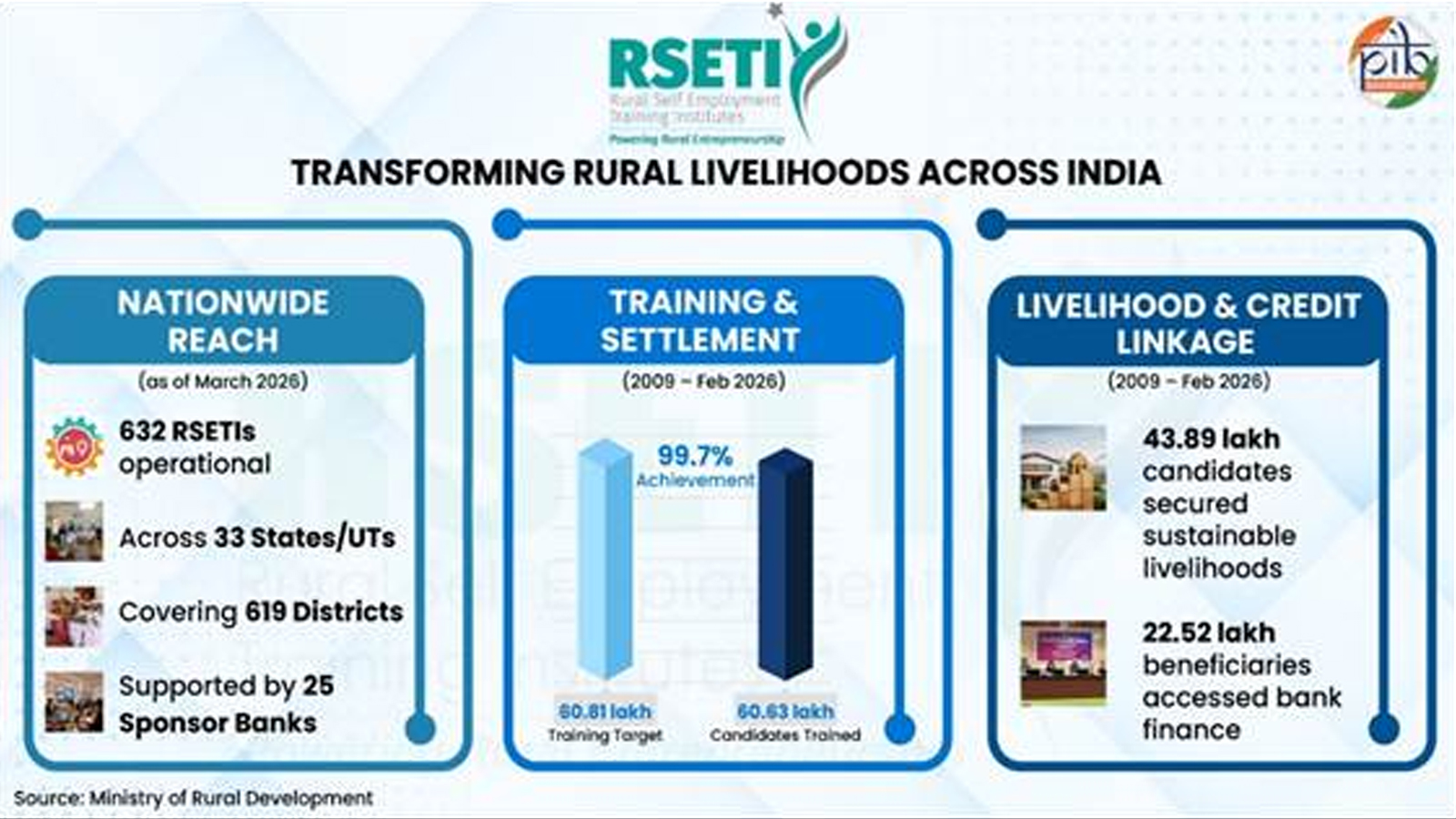
These individual success stories reflect the broader reach of the RSETI network across the country. As of March 2026, 632 Rural Self Employment Training Institutes were operational across 33 States and Union Territories, covering 619 districts with support from 25 sponsor banks.
Since their inception in 2009 until February 2026, the institutes have trained 60.63 lakh candidates, achieving nearly 99.7 per cent of the target of 60.81 lakh trainees. Of these, 43.89 lakh have secured sustainable livelihoods, while 22.52 lakh beneficiaries have received bank finance to establish their enterprises. The year 2024-25 marked the highest annual training achievement, with 6.21 lakh candidates trained.
The growing reach of RSETIs highlights how skill development, entrepreneurship and institutional support are fostering self-employment and strengthening rural economies. Beyond the statistics, the initiative is enabling individuals to overcome social and financial barriers, create employment opportunities and build sustainable enterprises, contributing to a more self-reliant rural India.


