







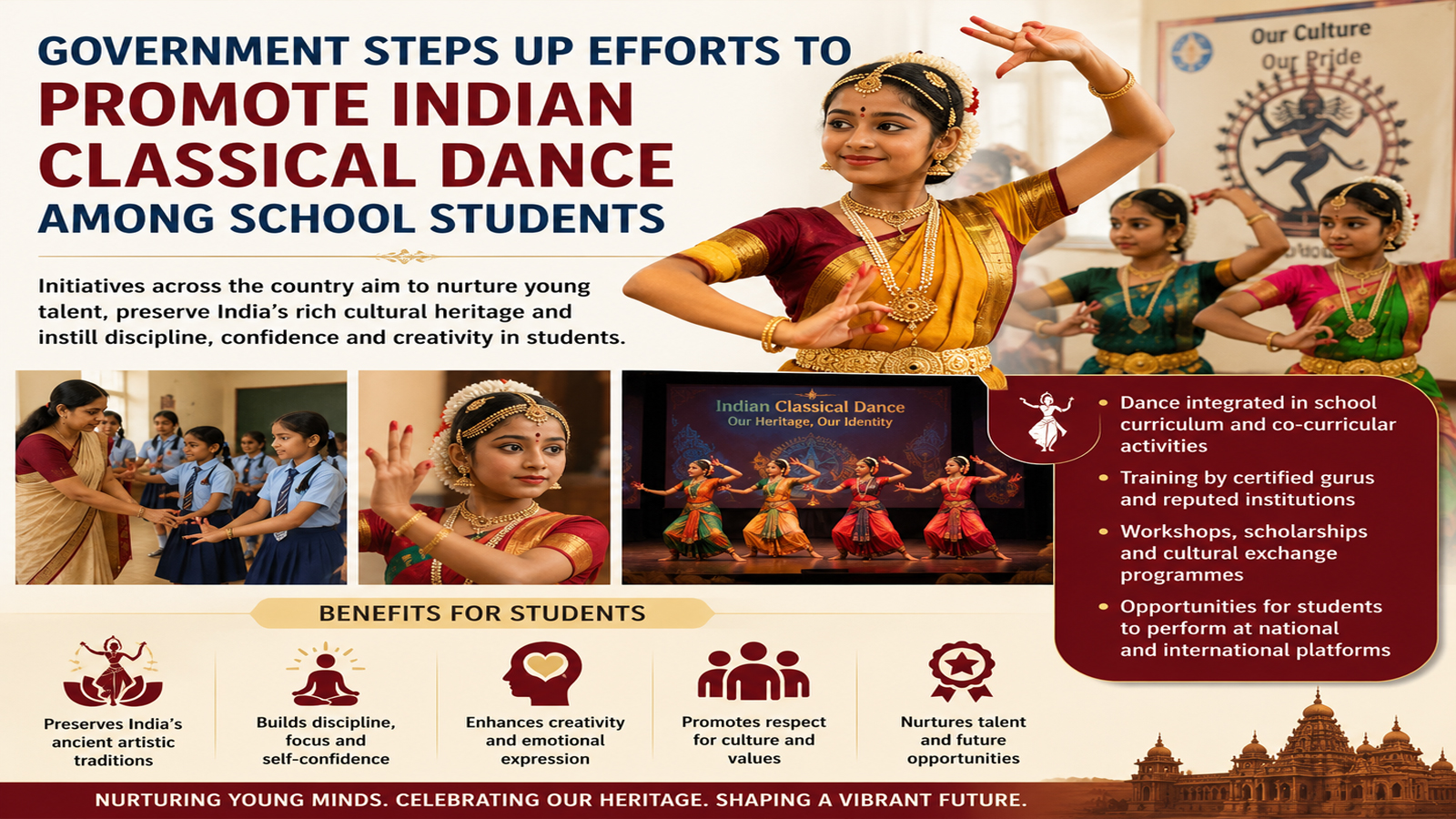
The government is promoting Indian classical dance among school students through training programmes, scholarships and cultural initiatives in line with the National Education Policy (NEP), 2020, Union Culture and Tourism Minister Gajendra Singh Shekhawat said on Monday.
In a written reply to the Lok Sabha, Shekhawat said the government is encouraging the inclusion of Indian classical and folk dance traditions in school education as part of NEP 2020’s emphasis on art-integrated, experiential and multidisciplinary learning.
The Centre for Cultural Resources and Training (CCRT), an autonomous organisation under the Ministry of Culture, conducts training programmes for teachers and students of government and government-aided schools, incorporating various Indian classical and folk dance traditions.
In Madhya Pradesh, the programmes cover dance forms including Kathak, Rai, Matki, Karma and Grida. The CCRT also operates a regional centre at Damoh to promote local and regional art forms.
The Sangeet Natak Akademi, another autonomous organisation under the Ministry of Culture, conducts the ‘Kala Dharohar’ series, featuring lectures, workshops and performances aimed at introducing school children to India’s performing arts traditions.
The Ministry of Culture is also providing specialised training opportunities to young students through the CCRT’s Cultural Talent Search Scholarship Scheme (CTSS).
Under the scheme, meritorious students aged 10 to 14 years studying in recognised schools, as well as children from families traditionally engaged in performing arts, can receive scholarships for specialised training in Indian classical dance and other cultural disciplines.
Each scholarship holder receives ₹3,600 annually, along with reimbursement of tuition fees paid to the Guru or teacher up to ₹9,000 per year, subject to scheme guidelines. The scholarship is initially awarded for two years and can be renewed based on satisfactory progress.
The number of scholarships awarded for Indian classical dance under the CTSS scheme has increased in recent years. A total of 225 scholarships were awarded in 2021-22, followed by 178 in 2022-23, 289 in 2023-24, 269 in 2024-25 and 313 in 2025-26.
This represents an increase of nearly 39% in the number of classical dance scholarships between 2021-22 and 2025-26.
The Ministry also supports young artists through the Scholarships to Young Artists in Different Cultural Fields (SYA) scheme. Under the programme, artists aged 18 to 25 years, including those specialising in Indian classical dance, receive ₹5,000 per month for advanced training for a period of two years.
Government funding for cultural organisations involved in promoting classical dance and other performing arts has also increased over the period. Grants released to organisations including the CCRT, Sangeet Natak Akademi and Kalakshetra Foundation rose from ₹106.94 crore in 2021-22 to ₹150.61 crore in 2025-26, despite fluctuations during the intervening years.
The amount released under the SYA scholarship scheme stood at ₹3.90 crore in 2021-22, ₹1.19 crore in 2022-23, ₹4.52 crore in 2023-24, ₹3.26 crore in 2024-25 and ₹5.38 crore in 2025-26.
The Ministry said these initiatives are aimed at creating greater exposure to India’s classical and folk traditions among young people while providing structured opportunities for talented students and emerging artists to receive training from experienced practitioners.
The initiatives also seek to strengthen the transmission of India’s performing arts traditions to younger generations and align cultural education with the broader objectives of NEP 2020.
Shekhawat said the Ministry, through its autonomous organisations and scholarship programmes, is continuing efforts to encourage students to learn and pursue Indian classical dance and other traditional art forms.


