







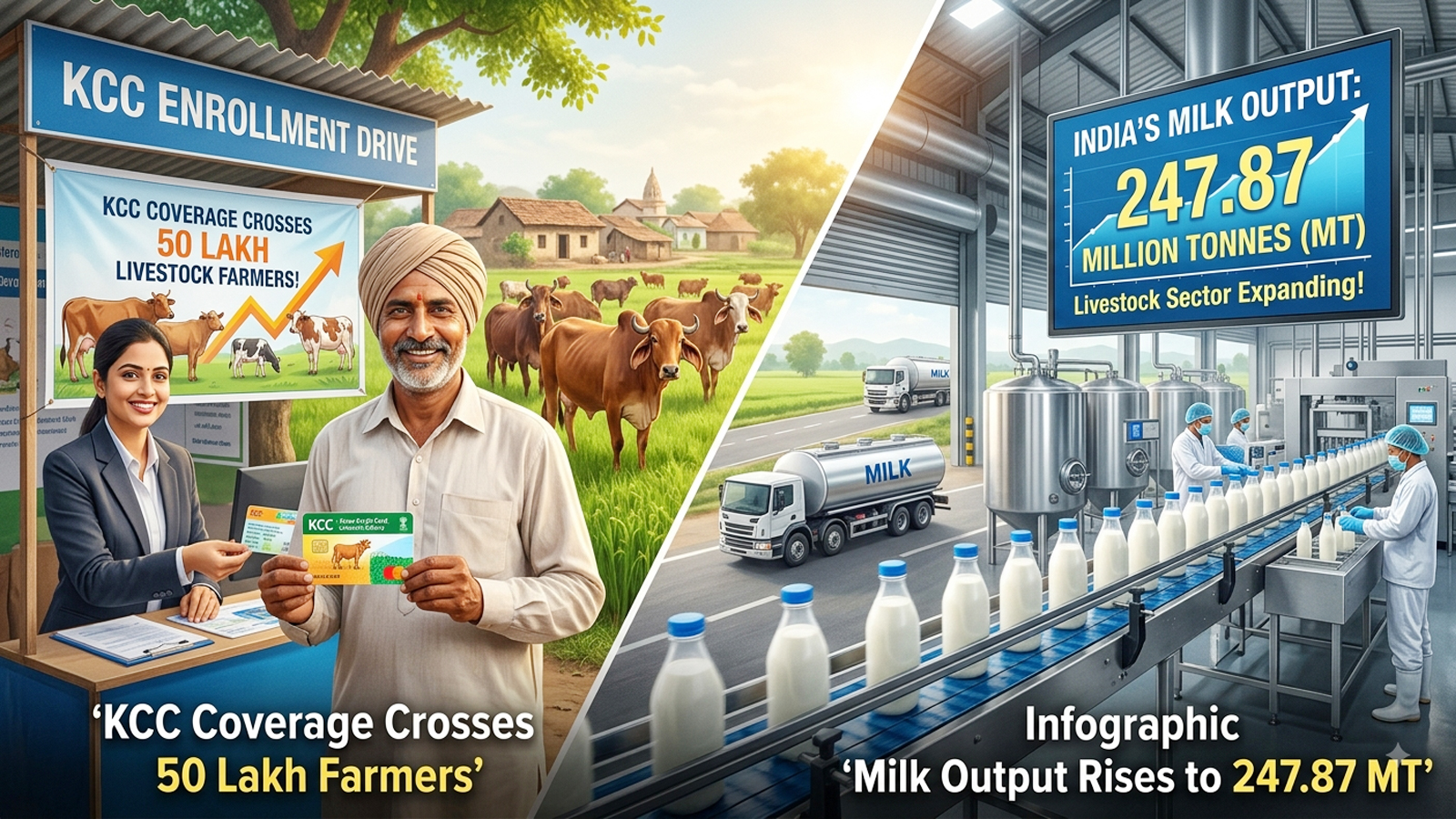
India’s livestock sector has recorded significant growth in institutional credit, milk production, scientific breeding and veterinary healthcare, with the number of animal husbandry farmers covered under the Kisan Credit Card (KCC) scheme rising to 50.42 lakh in 2025-26, Union Minister for Fisheries, Animal Husbandry and Dairying Rajiv Ranjan Singh said on Tuesday.
The minister said KCC coverage for livestock farmers had increased substantially from 15.08 lakh beneficiaries in 2021-22 to 50.42 lakh in 2025-26, reflecting growing access to institutional credit for the animal husbandry sector.
India’s annual milk production also reached 247.87 million tonnes in 2024-25, exceeding domestic demand of around 243 million tonnes. Dairy exports stood at $407.18 million in 2025-26, according to the ministry.
The Ministry of Fisheries, Animal Husbandry & Dairying is simultaneously expanding programmes aimed at improving livestock genetics, productivity, fodder availability and animal healthcare.
Focus on scientific breeding
The Rashtriya Gokul Mission (RGM), being implemented since December 2014, is focused on the development and conservation of indigenous cattle breeds, genetic improvement of the bovine population and increasing milk production and productivity.
The programme is intended to make dairy farming more remunerative by improving the productivity and genetic quality of livestock.
The National Livestock Mission (NLM), implemented since 2014-15, focuses on scientific livestock and poultry breeding, fodder development, entrepreneurship and improving per-animal productivity.
The scheme also seeks to generate employment and strengthen forward and backward linkages between livestock producers in the unorganised sector and organised markets.
Under the NLM Entrepreneurship Development Programme, individuals, Farmer Producer Organisations, Self-Help Groups, Joint Liability Groups, Farmer Cooperative Organisations and Section 8 companies can receive capital subsidies of up to 50 per cent for eligible activities.
The scheme covers areas such as livestock and poultry breed development, feed and fodder development, research and development, livestock insurance and extension services.
Strengthening disease control
The Ministry is also expanding measures to prevent economically important livestock diseases under the Livestock Health and Disease Control Programme (LHDCP).
Under the programme, the Centre provides 100 per cent financial assistance to States and Union Territories for vaccination against diseases including Foot and Mouth Disease (FMD), Brucellosis, Peste des Petits Ruminants (PPR) and Classical Swine Fever (CSF).
Financial assistance is also provided on a cost-sharing basis for state-prioritised activities, including vaccination against other livestock diseases, control of emerging and exotic diseases, strengthening laboratories, disease surveillance, training and awareness programmes.
245 mobile veterinary units in Tamil Nadu
In Tamil Nadu, the Ministry is providing financial assistance on a cost-sharing basis for the operation of 245 Mobile Veterinary Units (MVUs).
The mobile units are intended to deliver veterinary services directly to farmers, improving access to animal healthcare, particularly for livestock owners in areas where veterinary facilities may not be readily available.
The Ministry said the combined focus on institutional credit, scientific breeding, fodder development, disease prevention and doorstep veterinary care is aimed at improving livestock productivity, strengthening rural livelihoods and creating a more resilient animal husbandry sector.


