







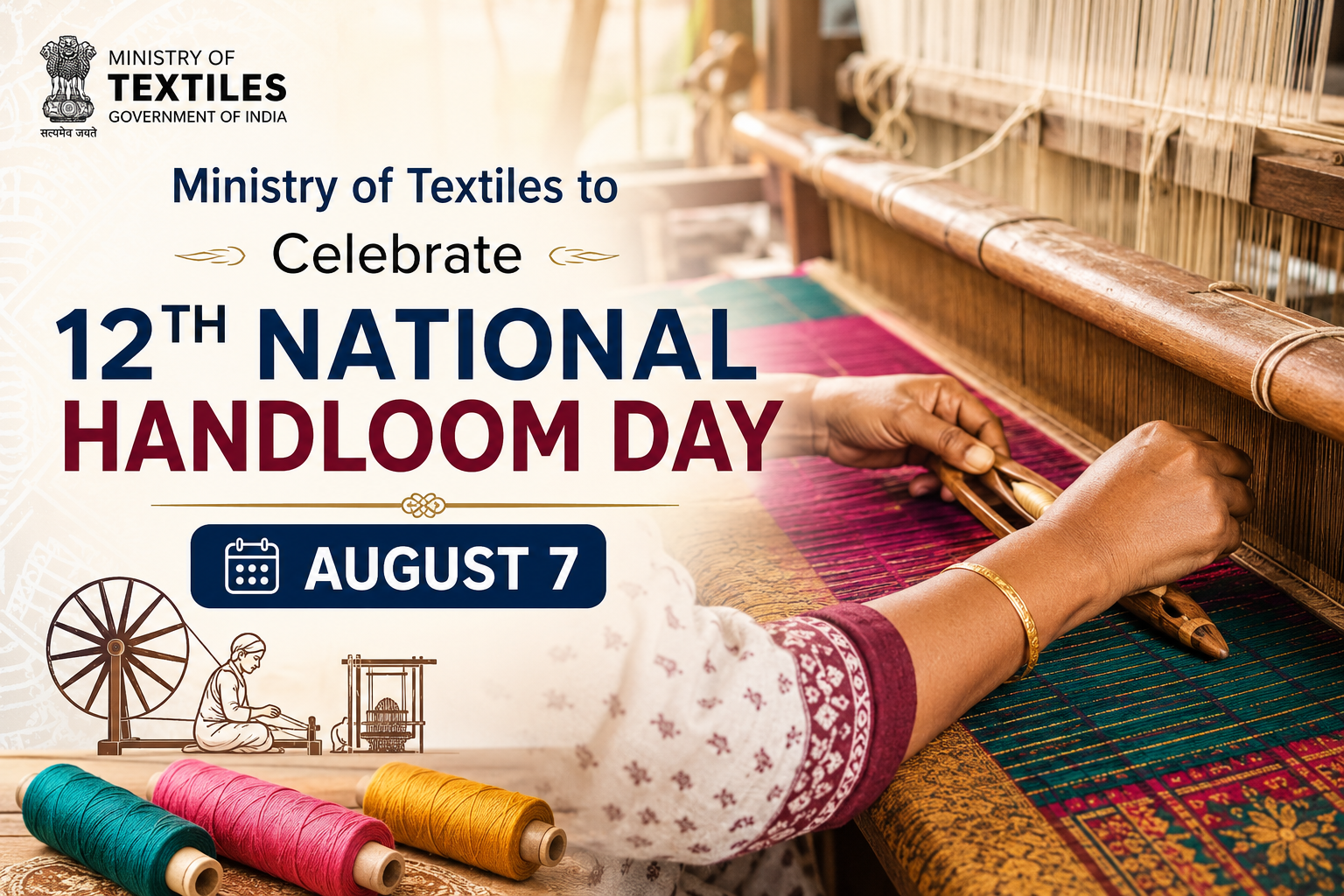
The Ministry of Textiles will celebrate the 12th National Handloom Day on August 7, 2026, with a national function at the Rashtrapati Bhavan Cultural Centre (RBCC) in New Delhi to commemorate India’s rich handloom heritage and honour the contribution of the weaving community to the country’s cultural and economic development.
President Droupadi Murmu will attend the event as the Chief Guest. Union Textiles Minister Giriraj Singh, Minister of State for Textiles Pabitra Margherita, Secretary (Textiles) Neelam Shami Rao, and Development Commissioner (Handlooms) Dr. M. Beena will also be present.
The event will be attended by recipients of the Sant Kabir Handloom Awards and National Handloom Awards, along with their family members, handloom weavers from across the country, members of the Awards Selection Committee, representatives of the handloom sector, senior government officials, media personnel and other distinguished guests.
A key highlight of the programme will be the presentation of the 2025 Sant Kabir Handloom Awards and National Handloom Awards. A total of 22 awards—comprising three Sant Kabir Handloom Awards and 19 National Handloom Awards—will be conferred on outstanding handloom weavers in recognition of their craftsmanship, innovation and contribution to preserving India’s handloom traditions.
The function will also witness the release of four commemorative postage stamps celebrating the country’s diverse handloom weaving traditions.
Two publications—”Earth. Root. Thread – Aal Dyed Handloom Textiles of Central India” and the Handloom Awards Book 2025—will also be unveiled during the event.
An exhibition featuring award-winning handloom products will be organised on the sidelines of the function. Visitors will also be able to witness live demonstrations of traditional Kani weaving and Wall Hanging weaving, showcasing the diversity and craftsmanship of India’s handloom heritage.
In addition to the main celebration on August 7, the Ministry has planned a series of events around National Handloom Day, including exhibitions, designer conclaves and programmes involving the Indian Institutes of Handloom Technology (IIHTs).
India’s handloom sector remains one of the country’s largest sources of sustainable rural employment, supporting the livelihoods of more than 35 lakh people, with women accounting for over 70 per cent of the workforce. Besides its economic importance, the sector plays a key role in preserving India’s textile traditions and promoting environmentally sustainable production practices.
National Handloom Day is observed annually on August 7 to commemorate the Swadeshi Movement, launched on August 7, 1905, which gave renewed impetus to indigenous industries and the handloom sector. The observance recognises the enduring contribution of handloom weavers to India’s cultural heritage and socio-economic development.
Since its inception in 2015, National Handloom Day has served as a platform to celebrate the artistry, skill and dedication of India’s handloom weavers while reaffirming the government’s commitment to the preservation, promotion and sustainable development of the handloom sector.


