For nearly six decades, Left-Wing Extremism (LWE) remained one of India’s most significant internal security challenges, affecting remote tribal regions, disrupting development and limiting access to basic services. What began with the Naxalbari uprising in 1967 evolved into a wider security and governance challenge, with Maoist groups expanding their influence across several states and prompting successive governments to balance counter-insurgency operations with development efforts.
That long-running challenge reached a significant turning point on March 31, 2026, when no district in the country remained officially classified as affected by Left-Wing Extremism. The milestone was the outcome of a multi-pronged strategy that combined stronger security operations with improved connectivity, infrastructure development, welfare delivery, rehabilitation measures and community engagement, marking a shift from a predominantly security-centric response to an integrated approach aimed at addressing the roots of the insurgency.
From fragmented response to integrated strategy
The roots of Left-Wing Extremism can be traced to the Naxalbari uprising in West Bengal in 1967. Inspired by Maoist ideology, the movement expanded over the decades, with several extremist groups later merging under the Communist Party of India (Maoist) in 2004.
Between 2004 and 2014, LWE violence reached its peak. The year 2010 witnessed the highest level of violence, with 1,936 incidents and 720 civilian deaths. Over the decade, more than 17,500 violent incidents were recorded, resulting in the deaths of security personnel and civilians.
A major policy shift came in 2015 with the introduction of the National Policy and Action Plan to address LWE. The approach moved beyond responding to attacks and focused on tackling the wider ecosystem that sustained extremism through security measures, development initiatives and improved governance.
The strategy was built around three interconnected pillars — security, development and community engagement. Security operations created conditions for stability, infrastructure projects expanded state presence, and welfare initiatives aimed to bring remote communities closer to mainstream development.
Strengthening security presence in former conflict zones
A key focus was establishing a stronger security network in areas where extremist groups had maintained influence for years.
The security infrastructure expanded significantly with the construction of fortified police stations, establishment of new security camps and improved operational coordination among central and state forces.
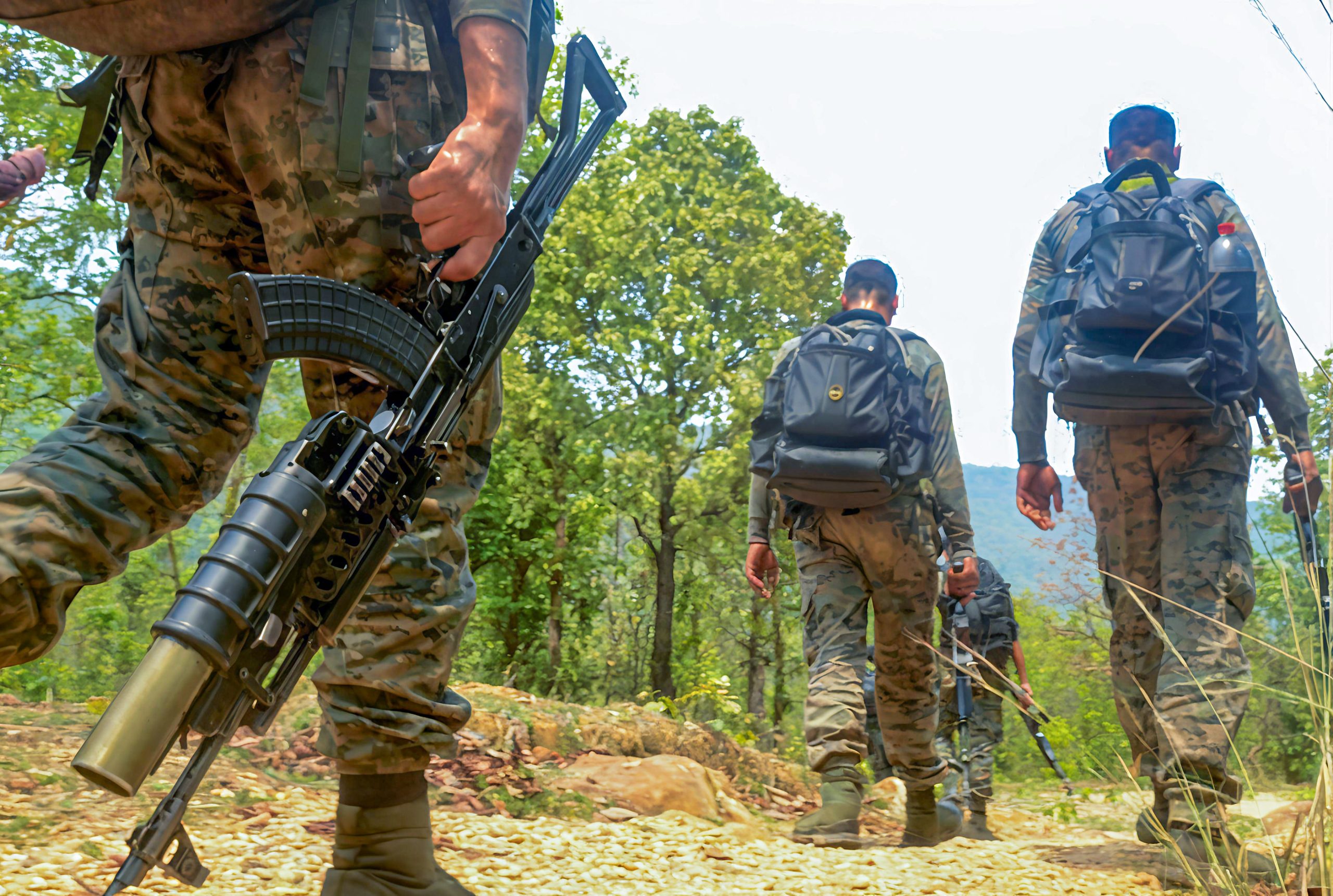
Specialised units such as the CoBRA battalions, District Reserve Guard (DRG), Special Task Forces (STF) and state forces including Jharkhand Jaguar and Greyhounds played an important role in intelligence-based operations and area domination.
Technology also became a major component of counter-LWE operations. Drones, satellite imagery, unmanned aerial vehicles, location-tracking systems and data analysis tools helped improve surveillance, intelligence gathering and operational planning.
Operations such as Black Forest, Octopus, Double Bull, Thunderstorm, Bhimbarg and Chakrabandha weakened Maoist networks by targeting leadership structures, weapon networks and operational bases.
Breaking the support network
The strategy against Left-Wing Extremism focused not only on armed cadres but also on financial and logistical networks supporting extremist activities.
Investigative agencies worked to disrupt funding channels, seize assets linked to extremist organisations and strengthen legal action against those involved in supporting Maoist networks.
Alongside security operations, rehabilitation programmes encouraged cadres to abandon violence and return to mainstream society.
Under surrender and rehabilitation policies, former cadres received financial assistance, monthly support, skill development opportunities and livelihood assistance. These measures helped create alternatives for those willing to give up armed activities.
Thousands of cadres surrendered in recent years, reflecting the declining influence of extremist organisations and growing confidence in rehabilitation measures.
Development reaches previously isolated areas
The fight against Left-Wing Extremism was not limited to security operations. Expanding infrastructure and improving access to basic services became central to transforming affected regions.
Road connectivity emerged as one of the biggest changes, with thousands of kilometres of roads constructed in LWE-affected areas. Improved roads connected remote villages with markets, schools, healthcare facilities and government services.
Digital connectivity also expanded rapidly. Thousands of mobile towers were installed, enabling communication access in areas that had remained disconnected for decades.
Financial inclusion improved through the expansion of banking facilities, ATMs, banking correspondents and post offices. These measures helped bring formal financial services closer to rural and tribal communities.
Education and skill development received greater focus through initiatives such as Eklavya Model Residential Schools, Industrial Training Institutes and skill centres. These programmes aimed to create better opportunities for tribal youth and support economic independence.
Tribal welfare and community participation
A major component of the transformation was improving welfare delivery among tribal communities.
Development programmes focused on housing, healthcare, education, livelihood opportunities, drinking water access and connectivity. The objective was to ensure that communities living in remote regions had access to the same opportunities available elsewhere.
Special initiatives for Particularly Vulnerable Tribal Groups (PVTGs) and tribal villages aimed to bridge infrastructure gaps and improve living standards.
Community participation also became an important element in rebuilding trust. Civic action programmes, medical camps, sports activities and local engagement initiatives helped strengthen interaction between security forces and residents.
Bastar: From conflict zone to development region
Chhattisgarh’s Bastar region became one of the most prominent examples of the changing landscape.
For years, Bastar remained at the centre of Maoist activity due to difficult terrain, limited connectivity and weak administrative presence. A combination of security operations, local recruitment, infrastructure development and welfare initiatives gradually changed the situation.
The formation of the Bastariya Battalion brought local youth into security operations, strengthening intelligence networks and community trust.
Improved road connectivity, mobile networks and government service centres helped connect remote villages with education, healthcare, banking and livelihood opportunities.
Cultural and youth initiatives, including platforms promoting tribal identity and participation, further supported social integration.
Declining violence and expanding governance
The impact of the decade-long transformation is visible in the decline of violence.
The number of LWE-affected districts fell from 126 in 2014 to zero by 2026. The number of highly affected districts also declined from 35 to zero.
Violence levels reduced sharply, with incidents and fatalities dropping compared to the peak years of the insurgency. The decline reflected weakened extremist networks, improved security coordination and stronger governance presence.
A new phase of peace and development
The journey from a conflict-affected landscape to a Naxal-free India represents a shift from a security-only approach to a broader model combining stability, development and inclusion.
The reduction of Left-Wing Extremism has opened opportunities for greater investment, improved public services and stronger integration of remote communities with the country’s development journey.
The challenge now moves from eliminating violence to sustaining peace, ensuring continued development and strengthening the trust built between communities and institutions.