







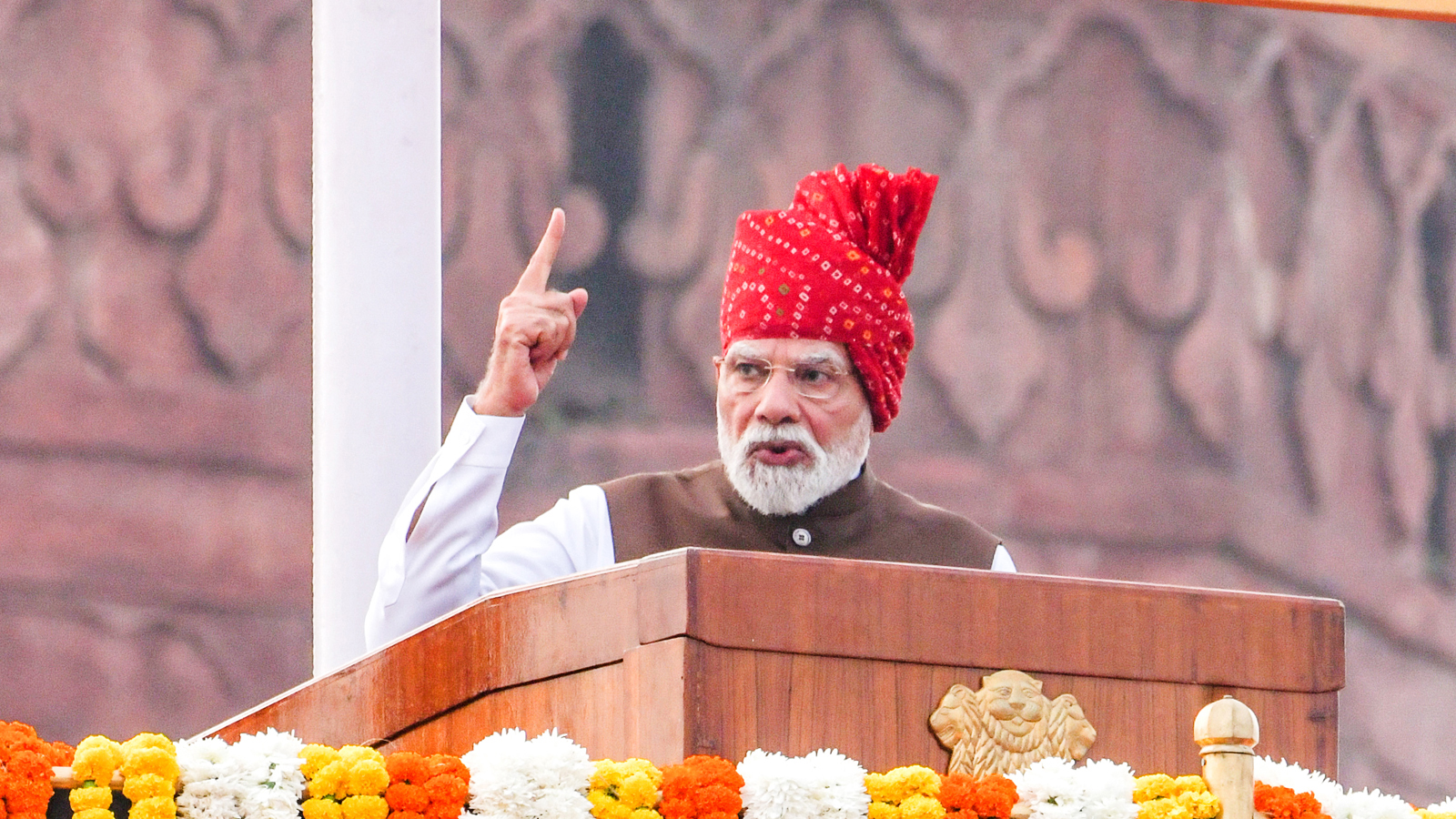
Prime Minister Narendra Modi, in his Independence Day address from the ramparts of the Red Fort on Saturday, laid out an ambitious roadmap for building a Viksit Bharat by 2047, calling for a fundamental change in the country’s work culture, thinking, pace of development and scale of ambition.
Addressing the nation on the 80th Independence Day, PM Modi said India could no longer afford to pursue small dreams and called upon citizens, governments, industry, farmers, youth and other sections of society to work together to achieve the country’s long-term goals.
“We can no longer move forward with small dreams. We must dream big, because big dreams expand our thinking. They broaden the horizons of our vision as well,” he said.
The Prime Minister said the next five to seven years would be critical for India and called for completing in that period tasks that had remained unfinished for decades.
“The work which has not been done in the last 5-7 decades, we have to do that work in the coming 5-7 years,” he said, expressing confidence in the country’s youth, women, farmers and workers.
‘Sapt Dhara’ to drive India’s next leap
A central theme of PM Modi’s address was the ‘Sapt Dhara’, or seven streams of strength, which he said would provide India with new momentum and help it achieve its development goals.
The seven areas identified by the Prime Minister are manufacturing, agriculture and food production, technology and innovation, Gati Shakti, defence, green and blue economy, and India’s soft power.
Calling manufacturing the first stream of Sapt Dhara, PM Modi said India must build complete value chains, from components and design to finished products, and emerge as a trusted hub in global supply chains.
He urged manufacturers, entrepreneurs and MSMEs to compete globally on cost, quality and scale.
“Our mantra should be quality, quality, quality. This will become our global brand value,” he said.
The Prime Minister stressed that Indian factories must become competitive, products user-friendly and packaging attractive, while zero-defect precision manufacturing should become a hallmark of Indian industry.
On agriculture, PM Modi called for moving “from the farm to the export market” and developing global brands around Indian millets, spices, fruits, flowers and traditional foods. He also stressed the importance of chemical-free farming and compliance with global quality standards.
India must become an innovation hub
Highlighting the rapid emergence of artificial intelligence, quantum technology, space, robotics and data centres, PM Modi said India must not remain merely a market for advanced technologies.
“We must not merely turn our country into a market for the world; we must become a hub of innovation,” he said.
He called for taking Indian digital public technologies to the world and set the goal of ensuring that Made-in-India 6G reaches every corner of the globe.
Under Gati Shakti, the Prime Minister called for seamless and faster connectivity through high-speed rail, modern highways, inland waterways, airports and multimodal logistics systems.
He also called for transforming ports into engines of port-led development and growth, rather than limiting their role to loading and unloading goods.
Self-reliance in defence is essential
Defence self-reliance formed another major part of the Prime Minister’s address.
“There is no alternative to being self-reliant in defence,” PM Modi said, adding that India must move from being a defence market to becoming a global supplier.
He called for the development of next-generation defence technologies, including drones, counter-drone systems and hypersonic defence technologies.
The Prime Minister also highlighted cybersecurity as an increasingly important area and said India’s youth could contribute significantly to building capabilities in this field.
He noted that India’s defence exports had increased substantially and said the country’s weapons were now reaching around 100 countries.
Green and blue economy offer major opportunities
PM Modi called for India to achieve global-scale capabilities in green hydrogen, renewable energy, energy storage, green mobility and green manufacturing.
He also highlighted the potential of the country’s long coastline in areas such as fisheries, coastal tourism and ocean technology.
“Bharat also has enormous opportunities in the blue economy,” he said.
The Prime Minister said India should continue offering solutions to global challenges such as climate change while creating new employment opportunities through the green economy.
India’s soft power can become global strength
The seventh stream of Sapt Dhara, according to PM Modi, is India’s soft power.
He called for taking India’s strengths in yoga, Ayurveda, holistic healthcare and the “Heal in India” initiative to the global stage.
He also identified handicrafts, culture, films, VFX, animation, gaming and digital content as areas with the potential to establish India as a major force in the global creative economy.
The Prime Minister called for greater efforts to attract foreign tourists and said India should aspire to host major international sporting events and concerts.
PM Modi calls for bigger ambitions
Calling on Indians to raise their aspirations, PM Modi set out a series of ambitious targets for Indian companies and institutions.
He asked why India should not have 50 companies among the Fortune 500 within the next decade.
He also said an Indian bank should be among the world’s five largest banks and that Indian pharmaceutical companies should feature among the global top five.
Similarly, he called for Indian law firms, rating agencies, consulting companies and accounting firms to become global leaders, while Indian technology companies and brands should establish a strong international presence.
“We have the talent. We have the capability. We have a long history. We have mastery over languages. We must reach the world,” he said.
‘Reforms are a conviction, not a compulsion’
The Prime Minister called for a renewed push for reforms and said the country’s policies, regulations and systems must reflect the aspirations of 2047 rather than the requirements of a bygone era.
“Reform is neither a compulsion for us, nor is reform a buzzword for us, this reform of ours is a conviction,” PM Modi said.
He said the Centre, state governments, industry, society, producers and farmers would all need to reform traditional systems, thinking and goals.
“We have embarked on the ‘Reform Express’ and we are going to move towards next level reform in the coming days as well,” he said.
PM Modi stressed that the next quarter of the 21st century would be decisive for India and that the country could not afford to slow its pace.
“Now we cannot stop, our pace cannot stop, our direction has been decided, we have to achieve it,” he said.
Youth at the centre of Viksit Bharat
The Prime Minister placed particular emphasis on the role of young Indians in the journey towards a developed India.
He noted that India now has more than 2.5 lakh registered startups and highlighted the government’s Innovation Fund of ₹1 lakh crore.
From the Red Fort, PM Modi announced a major initiative to train one crore young people in AI skills over the next year, saying this would equip India’s youth to lead in the global AI ecosystem.
“The youth have a very important role to play in the journey towards a ‘Viksit Bharat’. Not only that, the greatest beneficiary of a ‘Viksit Bharat’ will also be the youth of my country,” he said.
He also highlighted growth in India’s universities, medical education, startups, space sector, bioeconomy, electric mobility and aviation.
Free online coaching for competitive examinations
Addressing the concerns of middle-class families over the rising cost and pressure associated with coaching classes, PM Modi announced that the government would provide free online coaching for young people preparing for various examinations.
He said India’s digital public infrastructure, teachers and technology would be brought together to create an extensive network for online coaching.
Sports talent hunt for 2036 Olympics
With India seeking to host the 2036 Olympic Games, the Prime Minister called for a nationwide talent identification campaign targeting children between five and 15 years of age.
He said talent would be identified in villages, cities and schools and promising youngsters would receive specialised training.
“If we need athletes for 2036, we must focus today on these young boys and girls who are 5, 10 or 15 years old,” he said.
PM Modi also highlighted India’s growing sporting capabilities and said the country was moving forward as a strong contender to host the 2036 Olympics and would host the Commonwealth Games in 2030.
Call for a drug-free India
The Prime Minister described drug abuse as a major challenge for India’s youth and called for a collective campaign against it.
Referring to the 100-week Nasha Mukt Bharat campaign, involving MY Bharat volunteers, NGOs, social and cultural organisations and spiritual leaders, Modi urged every family to participate.
“A ‘Nasha Mukt Bharat’ or Drugs-Free India must be a collective responsibility for all of us,” he said.
Appeal to political parties on women’s reservation
PM Modi also made a direct appeal to political parties to implement women’s reservation.
Referring to the Nari Shakti Vandan Adhiniyam, he called for women to receive 33 per cent representation in the Lok Sabha and state legislative assemblies at the earliest.
“Let us become worshippers of the power of those women. Let us step forward to uphold their dignity and ensure that our mothers and sisters secure 33% representation in the Legislative Assemblies and the Lok Sabha as soon as possible,” he said.
He urged all political parties to work together to ensure greater participation of women in shaping the country’s policies.
Youth urged to participate in Census
The Prime Minister also called upon young people to help their families participate accurately in the ongoing Census exercise.
He stressed that Census data was critical for policymaking, government schemes and future planning.
PM Modi urged young people to sit with their families, understand the Census form, verify the information and use the digital process to ensure that details were recorded accurately.
“Counting is not just about figures. Policies are made from its details, plans are made, the country prepares its roadmap for moving forward and hence it is very important to have accurate information,” he said.
Self-reliance through semiconductors, critical minerals and energy security
The Prime Minister strongly reiterated the importance of Aatmanirbhar Bharat, saying India must strengthen its own capabilities rather than depend excessively on other countries.
He cited semiconductors as an example, noting that three semiconductor plants had already begun production and that several more were expected to become operational in the coming years.
He also highlighted the importance of critical minerals and said India was working through the National Critical Minerals Mission and the Critical Minerals Corridor to secure supplies needed for future technologies.
On energy security, PM Modi said India was targeting 100 GW of nuclear power capacity by 2047 and had set a target of starting five new nuclear reactors within the decade.
He also highlighted India’s progress in solar energy, piped gas infrastructure and railway electrification.
Hydrogen train, renewable energy and energy security
The Prime Minister pointed to India’s entry into the hydrogen-powered train sector as another milestone in its technological journey.
“The country has started its first hydrogen-powered train, and I am pleased that it is the longest and most powerful train of its kind,” he said.
He also highlighted the rapid expansion of solar power capacity and the progress of the PM Surya Ghar Muft Bijli Yojana, under which solar systems have been installed in 50 lakh homes.
India’s response to global crises
Reflecting on the challenges of the past decade, PM Modi referred to the COVID-19 pandemic, wars and disruptions in global supply chains.
He said India’s preparations under the principle of self-reliance had helped the country withstand global shocks.
Highlighting fertiliser prices, he said that while the international price of a sack of urea had reached ₹3,000, Indian farmers were being provided the fertiliser for ₹300. Similarly, DAP, which he said cost around ₹5,000 in global markets, was being supplied to farmers at ₹1,350.
The Prime Minister said that global crises had demonstrated the importance of strengthening domestic capabilities in areas such as energy, fertilisers, medicines, technology and other critical resources.
Security and ‘Mission Sudarshan Chakra’
PM Modi said India must remain prepared for emerging forms of warfare, noting that modern conflicts could target critical infrastructure such as refineries, banks and data centres.
He said work on Mission Sudarshan Chakra was progressing rapidly and stressed the need to modernise civil defence systems.
“The civil defence systems that have developed in our country in accordance with the wars of the last century have become outdated,” he said.
The Prime Minister announced plans to create a vibrant network of civil defence, including a large voluntary force trained to respond to modern crises.
Women’s economic empowerment
Highlighting the growing role of women in India’s development, PM Modi said women were leading in areas ranging from aviation and fighter jets to sports, STEM education and the armed forces.
He said the government had already exceeded its target of creating three crore Lakhpati Didis and was now working towards creating six crore Lakhpati Didis.
“The creation of 3 crore new Lakhpati Didis signifies a massive transformation in the rural economy driven by the power of women,” he said.
Naxalism and Maoism
The Prime Minister said India had made significant progress in eliminating armed Naxalism and Maoist violence.
He recalled the sacrifices of security personnel during decades of violence and said the government had resolved in 2014 to free the country from Naxalism.
“Naxalite-Maoist violence may no longer even have the strength to take its final breath. We are moving towards eliminating it completely,” he said.
At the same time, he warned against ideological extremism and called for continued vigilance.
Social security and healthcare
PM Modi said development would be meaningful only when it reached the last person.
He highlighted the expansion of social security coverage and the Ayushman Bharat scheme, under which senior citizens above 70 years are also eligible for free healthcare coverage up to ₹5 lakh.
He said the scheme had provided major financial relief to poor and middle-class families and helped save ₹2 lakh crore that otherwise would have been spent on medicines and medical procedures.
From ‘Panch Pran’ to Viksit Bharat
Concluding his address, PM Modi invoked the Panch Pran and called for an end to the mentality of slavery while drawing inspiration from the country’s freedom fighters and nation-builders.
He stressed that national interest must come before individual interest and that duty should define citizens’ identity.
“This is our time, this is our moment, and this is our resolve,” he said.
Calling for a collective national effort, the Prime Minister urged citizens to transform their aspirations into concrete action.
“Let us transform dreams into resolve, resolve into capability, and capability into success. Let us make every step a step of development, let us join step with step, let us connect our hearts, let us remain connected to the goal, one lamp will light thousands of lamps, let us together build a developed India,” PM Modi said.
He concluded his Independence Day address with chants of “Bharat Mata Ki Jai” and “Vande Mataram”, reiterating the call for citizens to work together towards building a Viksit Bharat by 2047.


