







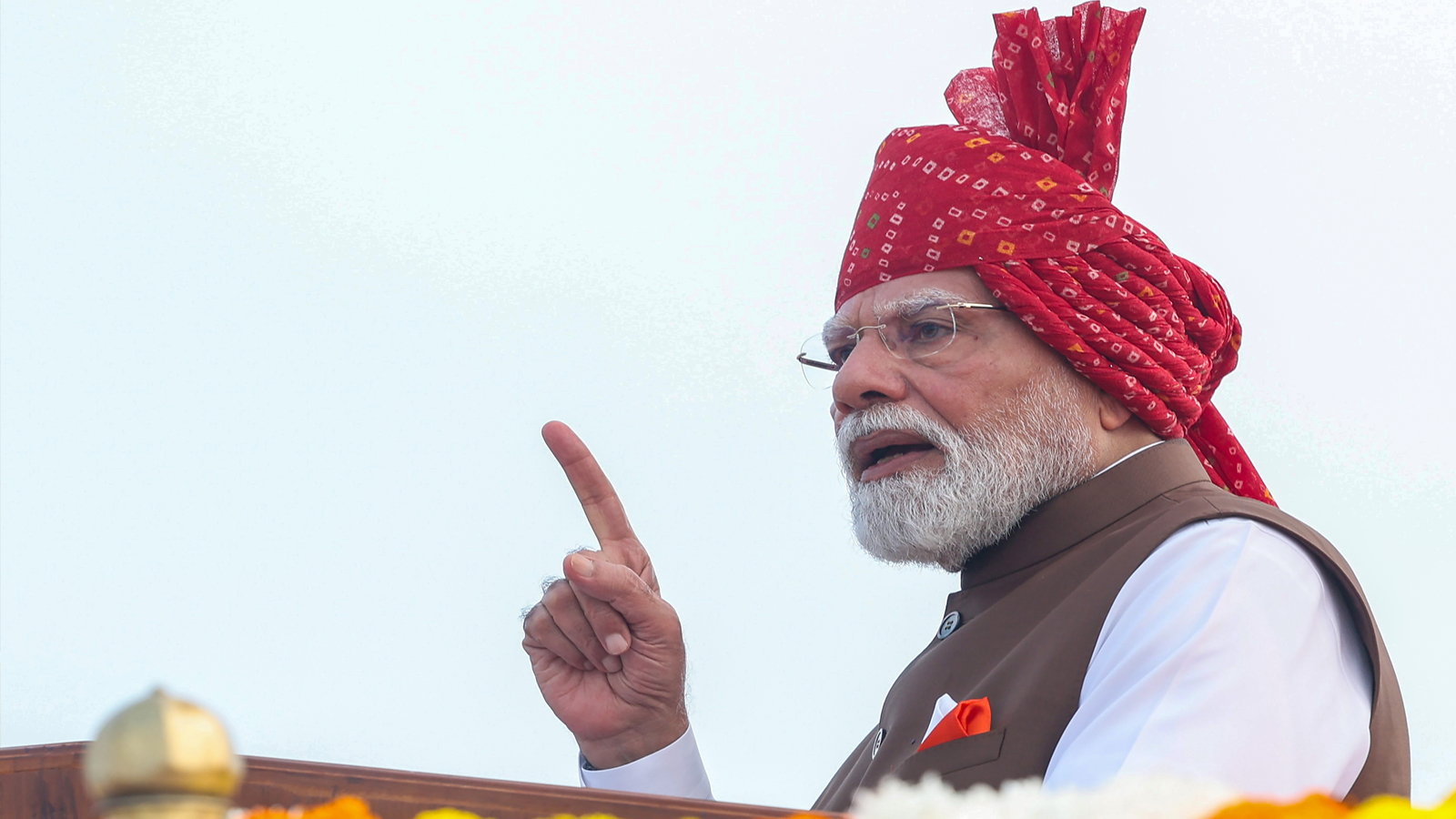
Prime Minister Narendra Modi on Friday called for strengthening India’s defence capabilities and achieving self-reliance in defence technology, asserting that ‘Raksha Shakti’ would be a key pillar in the country’s journey towards becoming a Viksit Bharat by 2047.
Addressing the nation from the ramparts of the Red Fort on the occasion of the 80th Independence Day, PM Modi said India could no longer remain dependent on other countries for defence requirements and must develop indigenous capabilities to protect its national interests.
As part of his ‘Saptadhara’ roadmap for Viksit Bharat, the Prime Minister stressed that India should move beyond being a market for global defence products and emerge as a global supplier of next-generation defence technologies.
“There is no alternative to being self-reliant in defence,” PM Modi said, calling for greater focus on the development of drones, counter-drone systems and hypersonic defence technologies.
The Prime Minister said the changing nature of warfare made it imperative for India to strengthen its indigenous defence ecosystem. He noted that modern conflicts were no longer necessarily confined to national borders and could increasingly threaten critical infrastructure such as refineries, banks, data centres and factories.
Referring to the government’s Mission Sudarshan Chakra, PM Modi said work on the initiative was progressing rapidly. He emphasised that India needed to enhance the capabilities of its armed forces and defence systems to remain prepared for emerging threats.
“Whether the challenge is within or beyond the borders, India is prepared for any situation,” the Prime Minister said, highlighting the country’s growing defence capabilities and its increasing standing on the global stage.
Defence production rises nearly four-fold
Highlighting the transformation of the defence sector over the past 12 years, PM Modi said India’s defence production has increased nearly four times, while defence exports have risen almost 50-fold.
Indian defence equipment is now being exported to around 100 countries, he said, underlining the country’s growing emergence as a defence manufacturing and export hub.
The Prime Minister linked the expansion of domestic defence manufacturing with the broader Aatmanirbhar Bharat initiative, saying that depending on imported products, even when they are cheaper or more readily available, does not help build India’s own capabilities.
He also pointed to the growing public support for initiatives such as Make in India, Swadeshi and Vocal for Local, saying these efforts were helping strengthen India’s domestic capabilities.
Cybersecurity emerging as a key defence priority
PM Modi also identified cybersecurity as an important area where India’s young talent could contribute to national security as well as address global requirements.
With technology becoming increasingly central to modern warfare, he called for harnessing the capabilities of India’s youth to build stronger cyber-defence capabilities.
Vibrant civil defence network planned
The Prime Minister also announced plans to create a vibrant nationwide civil defence network capable of responding to modern security challenges.
He said existing civil defence systems had largely evolved in response to the wars of the previous century and needed to be updated in view of the changing nature of threats.
The government, he said, would familiarise citizens with modern civil defence systems and create a large voluntary civil defence force to deal with emerging challenges.
PM Modi stressed that building a secure India was not solely the responsibility of the armed forces or the government, but required greater preparedness and participation from citizens as well.
Women playing greater role in defence forces
The Prime Minister also highlighted the expanding role of women in India’s defence forces, saying that women officers were increasingly demonstrating their leadership capabilities.
Referring to women graduating from the National Defence Academy (NDA), PM Modi said the country’s daughters were demonstrating their ability to lead India’s military with confidence and authority.
He said the growing participation of women in the armed forces was an important part of the broader vision of Nari Shakti-led nation building.
The Prime Minister’s emphasis on Raksha Shakti, indigenous defence production, advanced military technologies, cybersecurity and civil defence formed a key component of his broader roadmap for building a secure, self-reliant and globally competitive India by 2047.


