







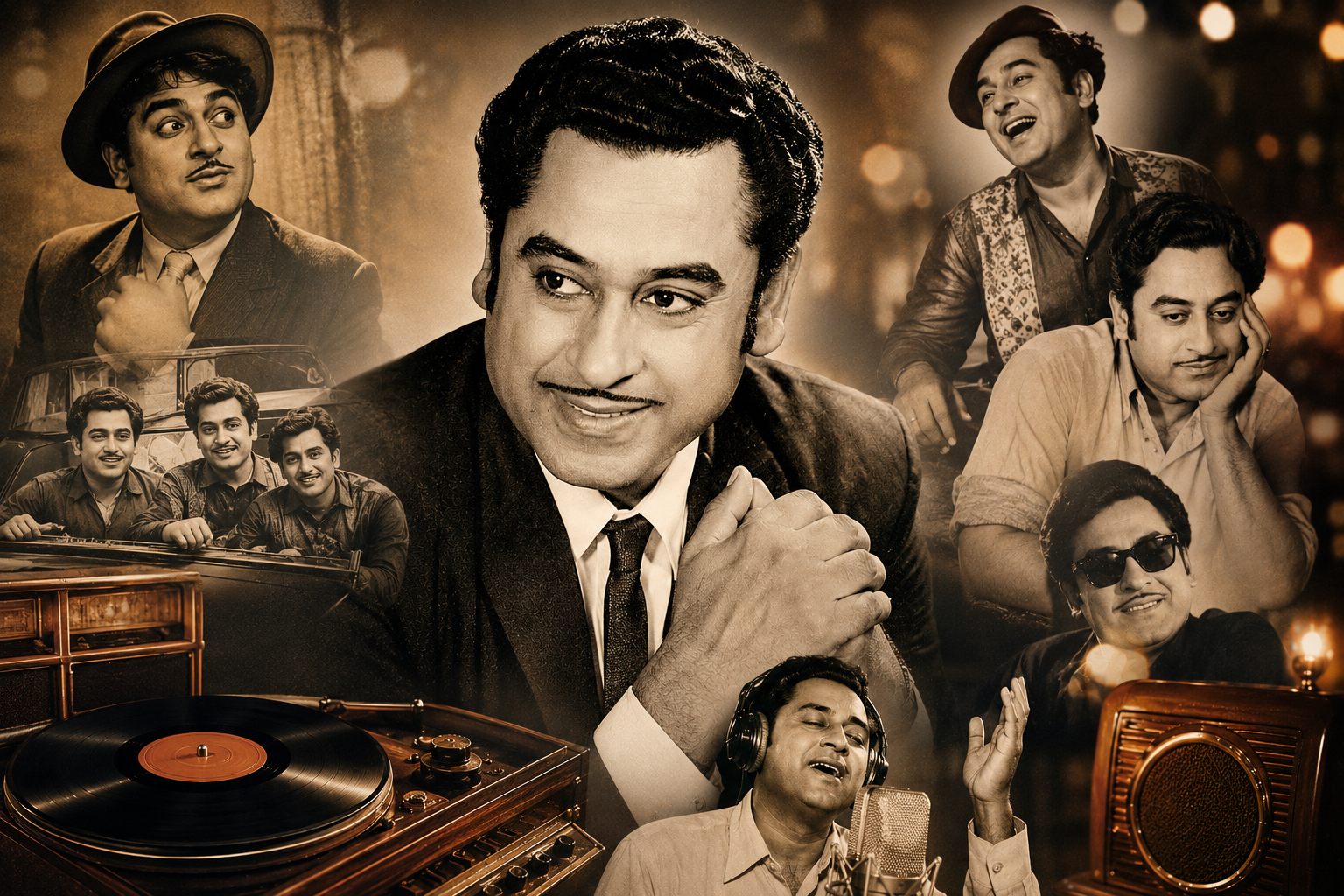
“Zindagi ek safar hai suhana…”
Some songs never grow old. They simply find new listeners.
Nearly four decades after Kishore Kumar’s passing, those opening words still have the remarkable ability to brighten a difficult day. They are more than lyrics from a beloved Hindi film song—they are part of India’s emotional vocabulary.
On his birth anniversary, remembering Kishore Kumar is not merely an exercise in nostalgia. It is a reminder of an artist whose voice continues to accompany people through life’s biggest moments and quietest emotions.
Born as Abhas Kumar Ganguly on August 4, 1929, in Khandwa, Madhya Pradesh, Kishore Kumar refused to fit into a single definition. He was a playback singer, actor, composer, filmmaker, producer, lyricist and entertainer. Yet none of these titles fully captured his genius. What made him extraordinary was his ability to make every song feel deeply personal, as though he were singing directly to the listener.
The Voice That Became a Companion
Every generation discovers Kishore Kumar in its own way.
For some, it begins with Mere Sapno Ki Rani, playing during family road trips. For others, it is the carefree optimism of Zindagi Ek Safar Hai Suhana. And then there are the quieter moments, when songs like Koi Humdum Na Raha, Badi Sooni Sooni Hai or Chingari Koi Bhadke seem to express feelings we struggle to put into words ourselves.
Few singers have travelled so effortlessly across the emotional spectrum. Love, longing, heartbreak, celebration, loneliness, hope, mischief or melancholy–Kishore Kumar sang them all with a sincerity that continues to resonate across generations.
Perhaps that is why his voice never feels dated. Emotions rarely do.
An Artist Who Refused to Be Ordinary
Long before individuality became fashionable, Kishore Kumar embraced it unapologetically.
Stories of his eccentric personality have become part of Bollywood folklore. He was known for his spontaneous humour, unconventional work habits, playful yodelling and a willingness to surprise people both on and off screen. While some anecdotes have undoubtedly grown with time, one thing remains beyond dispute–he refused to become predictable.
That originality extended to his music as well.
Despite having no formal training in classical music, Kishore Kumar relied on instinct, observation and experimentation to create a singing style unlike any other. Music directors such as S.D. Burman and later R.D. Burman recognised that uniqueness and encouraged him to develop it rather than imitate anyone else.
The result was a voice that sounded effortlessly natural, whether it belonged to Dev Anand’s charm, Rajesh Khanna’s romance or Amitabh Bachchan’s swagger.
Music That Keeps Finding New Lives
The true measure of an artist is not how popular they were in their own time, but how relevant they remain long after it.
Kishore Kumar’s songs continue to play at weddings, cafés, college festivals, long drives and family gatherings. They are rediscovered through streaming platforms, recreated by independent musicians and shared across social media by listeners who never saw him perform on screen.
His music has crossed generations without needing reinvention.
In an age where trends change almost overnight, that kind of longevity is rare.
Beyond the Laughter
On screen, Kishore Kumar could leave audiences laughing with films such as Half Ticket and Padosan. Off screen, however, he was a far more layered personality.
His life was marked by extraordinary success as well as personal challenges, relationships, health struggles and an intensely private nature. Those who knew him often described a man whose playful public image concealed remarkable emotional sensitivity.
Perhaps that emotional complexity explains why his songs continue to feel authentic. They were never merely performed—they were lived.
A Legacy That Lives On
Kishore Kumar’s legacy endures because his music belongs not to an era, but to life’s moments. Nearly four decades after his passing, his songs continue to comfort, celebrate and connect generations, proving that while time moves on, emotions remain timeless. Some voices entertain; Kishore Kumar’s became a lifelong companion to millions.


