







Ten years after its launch, the Government e-Marketplace (GeM) has evolved from a digital procurement platform into a major pillar of India’s public procurement ecosystem, bringing government buyers and sellers onto a common, technology-driven marketplace.
Launched on August 9, 2016, GeM was conceived to replace conventional, fragmented procurement processes involving paperwork, multiple approvals and lengthy tendering procedures with a transparent, paperless and technology-enabled system.
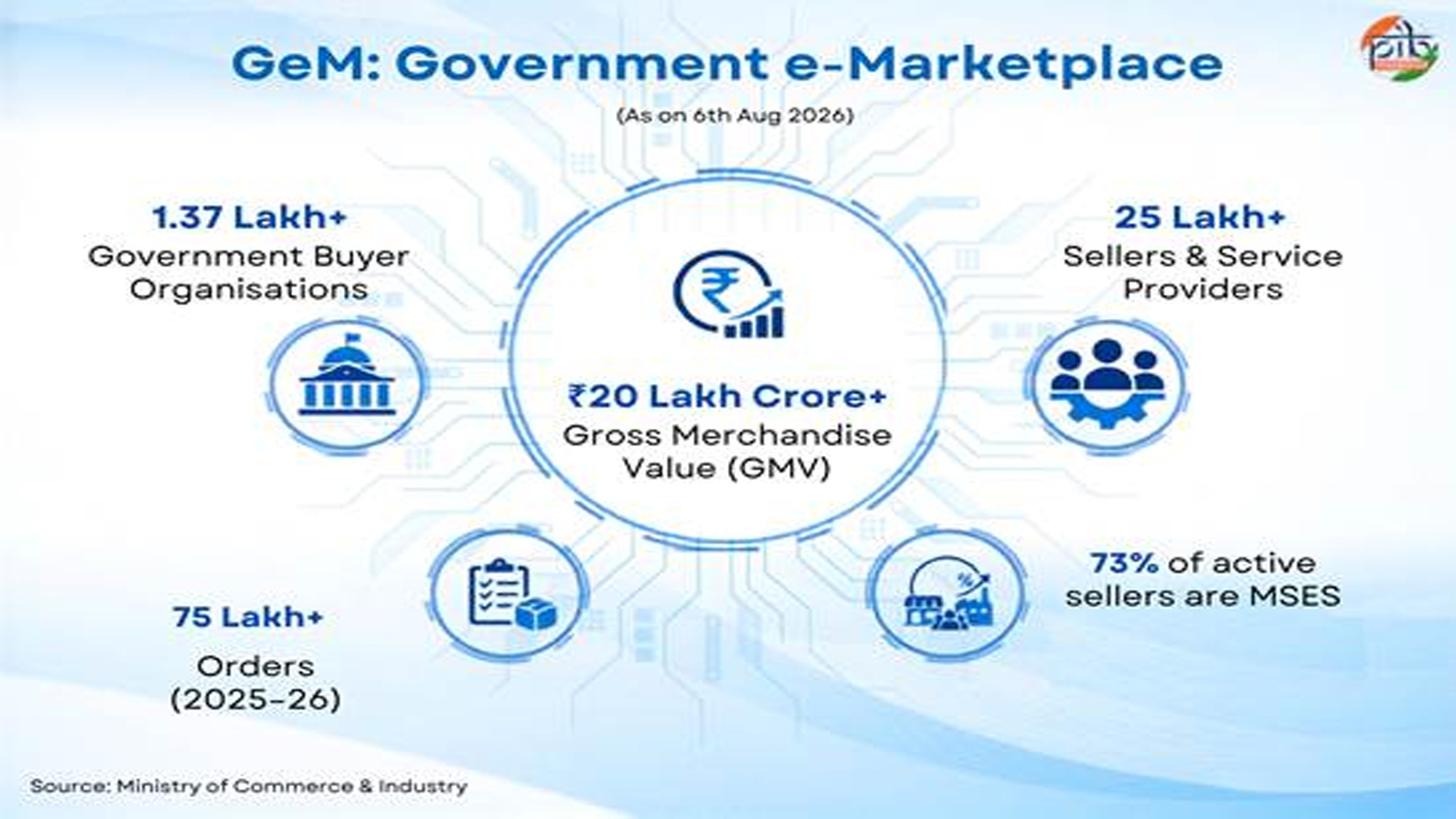
Today, the platform connects more than 1.37 lakh government buyer organisations with nearly 25 lakh sellers and service providers and has facilitated cumulative procurement worth more than ₹20 lakh crore.
From medical equipment and classroom furniture to computers, handicrafts, transport, catering and human resource services, GeM has expanded its reach across a wide range of government purchasing requirements.
The platform’s evolution reflects a broader transformation in how public procurement is conducted in India – from a largely manual process to an end-to-end digital ecosystem designed to improve transparency, efficiency, accountability and ease of doing business.
From conventional procurement to a digital marketplace
Before the emergence of GeM, public procurement often involved multiple layers of paperwork, approvals and tendering. Such processes could be time-consuming and fragmented, making procurement less efficient and limiting transparency.
GeM was introduced as a unified digital marketplace to address these challenges.
The platform enables government organisations to undertake the complete procurement lifecycle digitally, beginning with seller registration and product listing and extending through bidding, contract award, order fulfilment and payment.
The system brings government buyers and sellers together on a common online marketplace, allowing transactions to take place through a secure, paperless, cashless and contactless environment.
Its development drew upon global best practices, including leading public procurement systems in countries such as the United States and South Korea. The implementation of GeM was further strengthened through amendments to the General Financial Rules, enabling government organisations to procure goods and services through the platform.
The marketplace serves a broad range of public entities, including Central and State Ministries, government departments, public sector undertakings, autonomous bodies, local bodies, Panchayats and cooperatives.
Transparency at the centre
A central feature of GeM is its emphasis on transparent and standardised procurement.
Government buyers can use multiple procurement methods depending on their requirements, including direct purchase, comparison, electronic bidding and reverse auctions.
Digital records, real-time monitoring and automated workflows are intended to strengthen accountability while reducing discretionary decision-making.
The platform has also developed a range of data-driven tools to help government buyers make informed procurement decisions.
The GeM Availability Report and Past Transaction Summary allow buyers to assess product availability and examine previous procurement trends before making purchases outside the platform.
Business analytics tools provide information such as the Last Purchase Price, price trends and departmental procurement history, allowing buyers to assess prices and make more cost-effective procurement decisions.
The platform is also being developed as part of a wider interoperable public procurement ecosystem. Its integration with the Central Public Procurement Portal (CPPP) provides a single access point for government tender information relating to procurement undertaken across the country.
The functionalities of the Indian Railway Electronic Procurement System (IREPS) and the Defence Public Procurement Portal (DPPP) are also being integrated with GeM.
These efforts are aimed at creating greater interoperability and bringing different elements of government procurement into a more unified digital environment.
Defence emerges as a major contributor
The scale of procurement on GeM extends across the government’s diverse purchasing requirements.
The Department of Military Affairs has crossed ₹1.35 lakh crore in cumulative Gross Merchandise Value (GMV) on the platform as of August 6, 2026.
Defence procurement accounted for more than 14.93 per cent of GeM’s cumulative GMV as of the same date.
These figures highlight the growing role of the platform in meeting procurement requirements across major government sectors.
A marketplace spanning thousands of products and services
GeM currently offers more than 10,660 product categories and 350 service categories.
Its product marketplace includes medical equipment, furniture, computers, fire safety equipment and handicrafts, among numerous other requirements.
On the services side, government organisations can procure transport, catering, vehicle hiring and human resource services.
Multiple procurement modes, integrated payment systems and online contract generation allow transactions to be completed through an end-to-end digital process.
The platform has also introduced policy and technology reforms to simplify procurement. These include Rate Contracts for recurring purchases and the removal of Caution Money requirements for sellers.
Such measures are intended to simplify participation and improve the ease of doing business on the platform.
GeM and the wider digital governance agenda
GeM’s role extends beyond simply facilitating transactions.
The platform has become an important component of India’s Digital Procurement Ecosystem and supports broader national objectives including Digital India, Make in India, Aatmanirbhar Bharat, Vocal for Local and Ease of Doing Business.
By connecting government demand with businesses and service providers through a digital marketplace, the platform provides sellers with access to a large public procurement market while enabling government buyers to access products and services through standardised digital processes.
The marketplace has also been designed to broaden participation in government procurement, particularly among enterprises and groups that have traditionally faced greater barriers in accessing government markets.
Opening government markets to MSEs
Micro and Small Enterprises (MSEs) have become an important part of the GeM ecosystem.
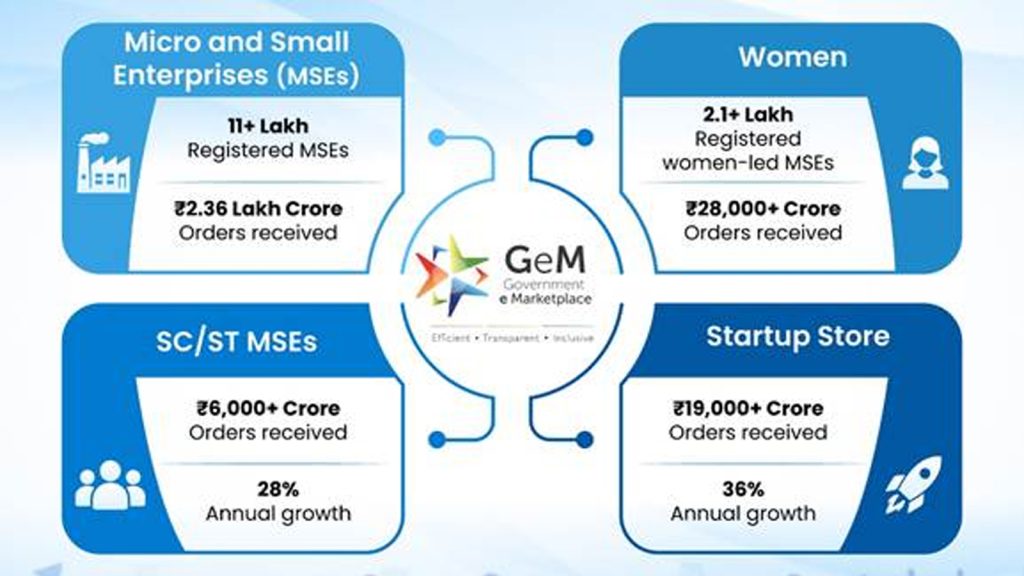
During 2025-26, more than 11 lakh MSEs were registered on the platform and executed more than 51 lakh orders worth over ₹2.36 lakh crore.
The figures indicate the extent to which digital procurement can provide smaller enterprises with access to government buyers.
GeM has also introduced dedicated initiatives aimed at encouraging participation by startups, women entrepreneurs, youth, Self Help Groups and other underserved groups.
Among these initiatives are SWAYATT, Startup Runway 2.0, Womaniya and the SARAS Collection.
Women-led enterprises gain greater access
Women entrepreneurs have received dedicated attention through GeM’s inclusive procurement initiatives.
More than 2.1 lakh women-led MSEs were registered on the platform in 2025-26 and secured procurement worth more than ₹28,000 crore.
The Womaniya initiative showcases products made by women entrepreneurs and Women Self-Help Groups on GeM, helping them access government procurement opportunities and expand their markets.
The initiative is part of the platform’s broader effort to make public procurement more inclusive and create greater opportunities for women-led enterprises.
Supporting SC/ST enterprises
GeM has also expanded procurement opportunities for enterprises belonging to socially disadvantaged groups.
During 2025-26, procurement from SC/ST enterprises exceeded ₹6,000 crore, registering nearly 28 per cent annual growth.
The platform’s technology-driven approach allows such enterprises to participate in government procurement through a standardised digital environment rather than relying solely on conventional market-access mechanisms.
Startups find a government marketplace
Startups are another category that GeM has sought to bring into the public procurement ecosystem.
Procurement from startups crossed ₹19,000 crore in 2025-26, registering annual growth of more than 36 per cent.
Through Startup Runway 2.0, startups have access to a dedicated marketplace where they can showcase innovative products and services to government buyers and participate in public procurement.
The initiative is designed to help bridge the gap between innovation and government demand.
SWAYATT, SARAS and other inclusion initiatives
GeM’s SWAYATT – Startups, Women & Youth Advantage through e-Transactions – is a flagship initiative aimed at promoting inclusive public procurement.
It enables startups, women entrepreneurs, MSEs and Self Help Groups to sell products and services to government buyers.
The SARAS Collection, meanwhile, provides a dedicated marketplace category for daily-use products made by rural Self Help Groups. It seeks to provide rural SHGs with access to Central and State government buyers.
Together, these initiatives seek to expand the range of participants in public procurement and connect government demand with enterprises operating at different levels of the economy.
Taking procurement support to the last mile
GeM’s efforts to broaden participation have also moved beyond the digital marketplace itself.
In June 2026, GeM partnered with Common Service Centre e-Governance Services India Limited (CSC-SPV) to establish 50 GeM Suvidha Kendras on a pilot basis across selected States and Union Territories.
The centres are intended to provide last-mile support to potential sellers and businesses.
Their services include awareness generation, seller registration, vendor assessment, catalogue creation, capacity building and grievance redressal, along with local handholding.
The initiative specifically seeks to increase the participation of MSEs, women entrepreneurs, SC/ST entrepreneurs, startups, artisans, weavers, SHGs and local manufacturers in government procurement.
By combining the digital marketplace with physical support at the local level, GeM aims to reduce barriers that may prevent smaller businesses from participating effectively.
Building partnerships around procurement
The expansion of GeM has also been supported by partnerships with government institutions, financial organisations, industry bodies and international agencies.
In April 2025, GeM partnered with the Indian National Space Promotion and Authorization Centre (IN-SPACe) for space-tech procurement and with the Drone Federation India (DFI) for drone procurement.
These partnerships are intended to expand the platform’s ability to support emerging technology sectors and innovative procurement requirements.
Financing sellers through GeMSahay
Access to working capital can be a challenge for smaller businesses fulfilling government orders.
To address this, GeM has developed GeM Sahay, a dedicated mobile application through which eligible proprietorship sellers can access instant, collateral-free working capital loans.
The initiative, supported through a partnership with Union Bank of India, enables quick and paperless financing without requiring buyer consent.
The objective is to help registered sellers and service providers obtain working capital and fulfil government orders more seamlessly.
Training, research and capacity building
GeM has also entered into partnerships aimed at strengthening knowledge, training and research in public procurement.
MoUs with the Arun Jaitley National Institute of Financial Management (AJNIFM), CareEdge Ratings, National Centre for Goods Governance (NCGG) and the Indian Institute of Public Administration (IIPA) support research, training, knowledge exchange and policy development in public procurement.
These partnerships form part of the effort to build greater institutional capacity around digital procurement.
Strengthening compliance through integration
Digital procurement also requires effective compliance mechanisms.
GeM has integrated with the Employees’ Provident Fund Organisation (EPFO) to enhance transparency and strengthen compliance with relevant Acts in manpower outsourcing services.
Such integrations are aimed at ensuring that digital procurement is accompanied by stronger regulatory and compliance processes.
Promoting gender-responsive procurement
GeM’s partnership with UN Women supports women-led enterprises through the Womaniya initiative.
The focus is on promoting gender-responsive and inclusive public procurement by creating greater visibility and market access for products and services offered by women entrepreneurs and women’s Self Help Groups.
This adds an inclusion-oriented dimension to GeM’s broader digital procurement framework.
From a marketplace to an integrated procurement ecosystem
The transformation of GeM is not limited to putting existing procurement procedures online.
The platform has progressively developed a range of tools, integrations, partnerships and procurement mechanisms designed to make public purchasing more transparent and data-driven.
The availability of price information, procurement history, transaction summaries and analytics allows buyers to use data when making purchasing decisions.
At the same time, digital records and automated workflows provide a more traceable procurement process.
The integration of other procurement platforms and systems is intended to reduce fragmentation and move towards a more unified digital ecosystem.
The scale of GeM’s transformation
The numbers illustrate the scale of the platform’s growth.
With more than 1.37 lakh government buyer organisations, nearly 25 lakh sellers and service providers and cumulative procurement exceeding ₹20 lakh crore, GeM has become a significant channel for public procurement.
Its catalogue of more than 10,660 product categories and 350 service categories covers an extensive range of government requirements.
At the same time, the participation of more than 11 lakh MSEs, over 2.1 lakh women-led MSEs and growing numbers of startups and SC/ST enterprises demonstrates the platform’s effort to broaden access to government markets.
The objective is not only to make government purchasing faster and more transparent but also to connect public demand with a wider and more diverse supplier base.
The next phase: smarter public procurement
As GeM enters its 11th year, the focus is shifting towards a smarter and more integrated public procurement ecosystem.
The platform’s future direction includes greater use of artificial intelligence, wider participation and deeper integration of procurement systems.
AI and data-driven tools are expected to further strengthen transparency, efficiency and governance, while wider participation can help connect government demand with local enterprises across the country.
This approach is closely aligned with the objectives of Vocal for Local, Make in India and inclusive economic growth.
From replacing paperwork with digital workflows to bringing millions of sellers into a common marketplace, GeM’s evolution reflects the broader digital transformation of government services.
The platform now sits at the intersection of procurement, technology, inclusion and public-sector demand – creating a digital channel through which government purchases can support both administrative efficiency and broader participation in the economy.
As it moves into its 11th year, GeM’s stated direction is clear: build a procurement ecosystem that is more digital, data-driven, transparent, inclusive and integrated, while supporting India’s journey towards a digitally empowered and self-reliant economy.


