







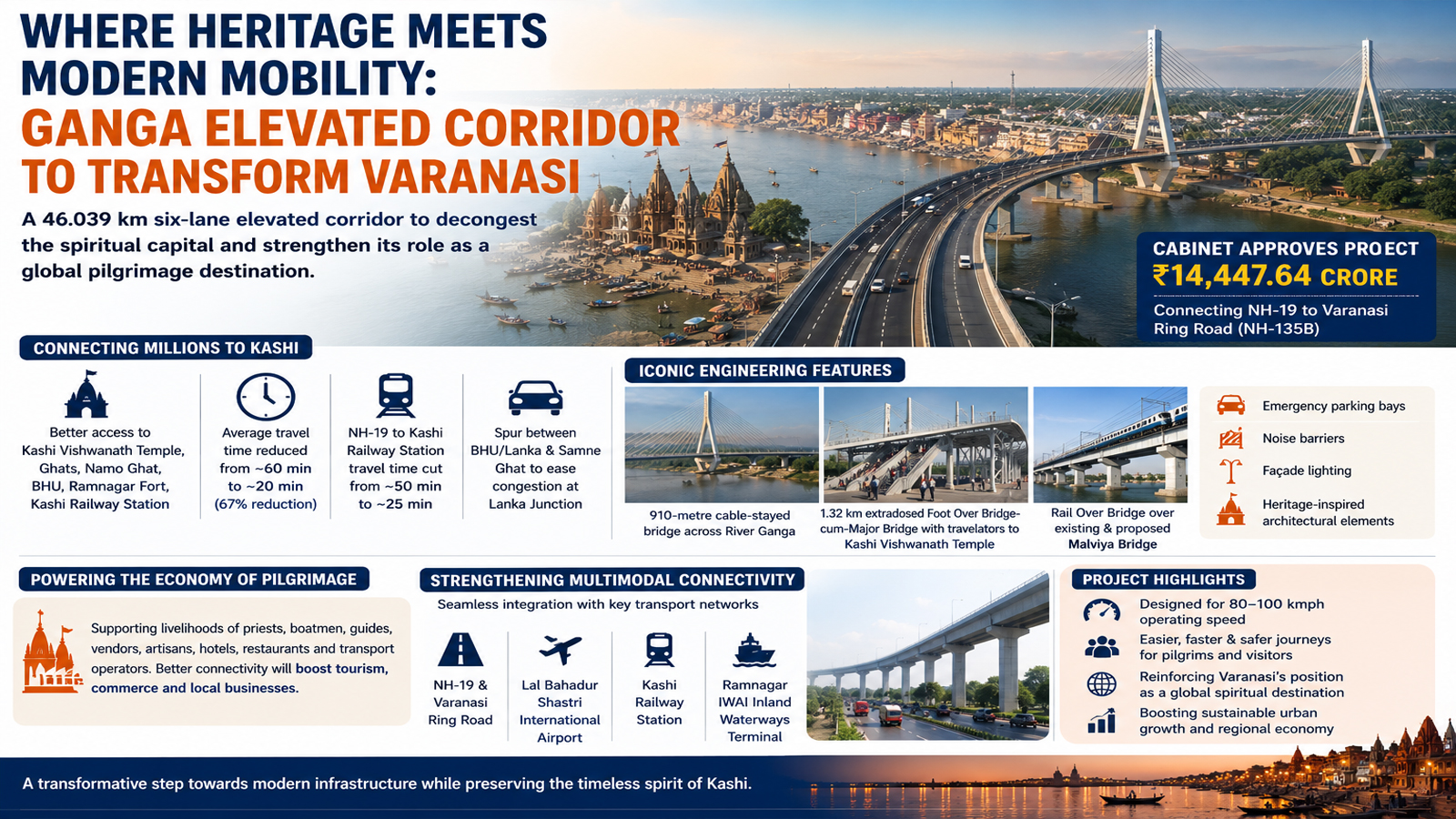
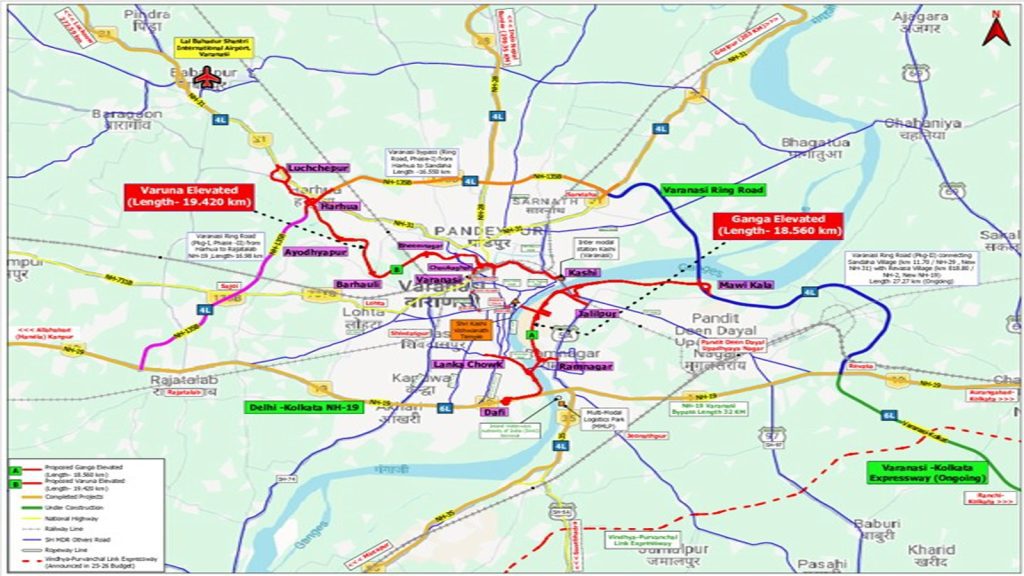
Varanasi, one of the world’s oldest continuously inhabited cities and India’s spiritual capital, is set for a major infrastructure transformation with the construction of a 46.039-km six-lane Greenfield Ganga Elevated Corridor. Approved by the Union Cabinet on July 15, 2026 at an estimated cost of ₹14,447.64 crore, the project aims to modernise urban mobility while preserving the city’s cultural and spiritual heritage.
Welcoming more than 15 crore pilgrims and tourists annually, Varanasi has witnessed growing pressure on its transport network, leading to congestion on major roads and longer travel times to religious, educational and cultural landmarks. The Ministry of Road Transport and Highways (MoRTH) has conceived the elevated corridor as a long-term solution to these challenges, connecting NH-19 with the Varanasi Ring Road (NH-135B) through a high-speed, access-controlled route that will improve connectivity across the city and neighbouring Chandauli district.
The project is expected to significantly enhance access to some of Varanasi’s most iconic destinations, including the Kashi Vishwanath Temple, the city’s historic ghats, Namo Ghat, Banaras Hindu University (BHU), Ramnagar Fort and Kashi Railway Station. An elevated spur connecting BHU/Lanka with Samne Ghat will help decongest the busy Lanka Junction by separating through traffic from local vehicular movement, making travel smoother for both residents and visitors.
Designed for operating speeds of 80 to 100 kilometres per hour, the corridor is expected to reduce average travel time across the project area from nearly 60 minutes to about 20 minutes, representing a reduction of around 67 per cent. Travel between NH-19 and Kashi Railway Station is also projected to be cut from nearly 50 minutes to approximately 25 minutes, providing faster and more reliable connectivity for pilgrims, tourists and commuters.
Recognising Varanasi’s unique historical and cultural significance, the project incorporates several landmark engineering features that seek to blend modern infrastructure with the city’s heritage. These include a 910-metre cable-stayed bridge across the River Ganga, a 1.32-km extradosed Foot Over Bridge-cum-Major Bridge equipped with travelators to provide seamless pedestrian access to the Kashi Vishwanath Temple, and a Rail Over Bridge spanning the existing and proposed Malviya Bridge.
The corridor will also feature dedicated emergency parking bays, noise barriers, façade lighting and architectural elements inspired by the cultural identity of Varanasi. These additions are intended not only to improve mobility but also to enhance the city’s urban landscape while creating new architectural landmarks.
Beyond easing traffic congestion, the project is expected to provide a significant boost to Varanasi’s pilgrimage-driven economy. Millions of visitors support a wide network of livelihoods, including priests, boatmen, tour guides, flower vendors, artisans, handicraft sellers, transport operators, hotels and restaurants. By improving accessibility and reducing travel delays, the corridor is expected to encourage longer visitor stays and greater exploration of the city’s religious, cultural and commercial attractions, generating wider economic benefits for local businesses and communities.
The project also aligns with the PM Gati Shakti National Master Plan, strengthening multimodal connectivity by integrating highways, railways, airports and inland waterways. It will improve access to NH-19, the Varanasi Ring Road, Lal Bahadur Shastri International Airport, Kashi Railway Station and the Ramnagar Inland Waterways Authority of India (IWAI) terminal, enabling more efficient movement of passengers and freight.
According to the Ministry, the Ganga Elevated Corridor represents more than a transport infrastructure project. By combining faster connectivity, advanced engineering and heritage-sensitive design, it seeks to strengthen Varanasi’s role as a global spiritual destination while supporting sustainable urban development, improved logistics and long-term regional economic growth.


