







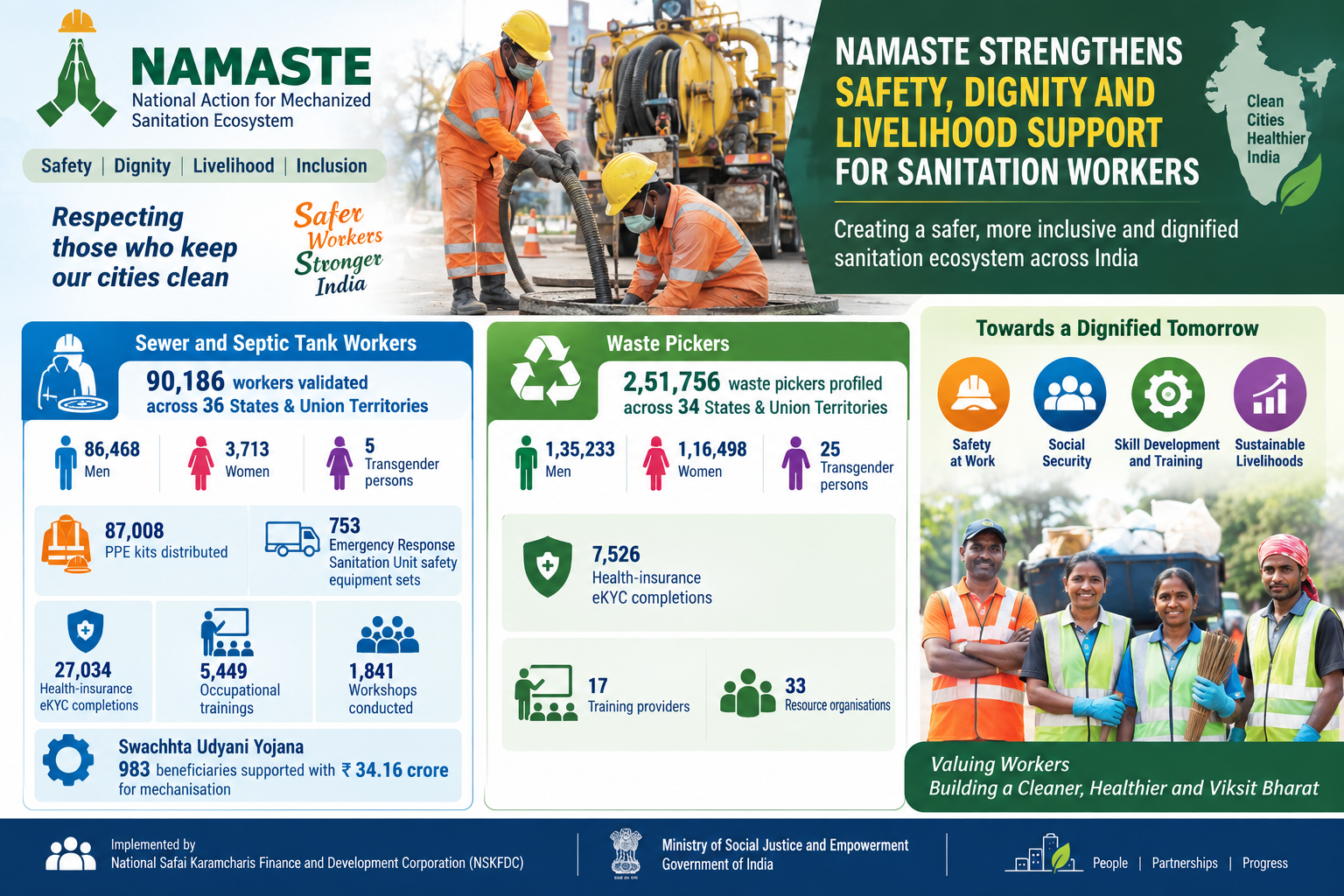
The National Action for Mechanized Sanitation Ecosystem (NAMASTE) Scheme is strengthening safety, dignity and livelihood support for sanitation workers through interventions covering occupational safety, health insurance, training and mechanisation.
Secretary, Ministry of Social Justice and Empowerment, Sudhansh Pant said that, as of September 22, the sewer and septic tank workers component of the scheme covers all 36 States and Union Territories and has validated 90,186 workers.
The validated workforce includes 86,468 men, 3,713 women and five transgender persons.
Under the scheme, more than 87,008 Personal Protective Equipment (PPE) kits and 753 Emergency Response Sanitation Unit safety equipment sets have been distributed among stakeholders.
The Ministry has also completed 27,034 health-insurance eKYC processes and conducted 5,449 occupational training programmes and 1,841 workshops for sewer and septic tank workers.
Under the capital-subsidy intervention for mechanisation through the Swachhta Udyami Yojana, 983 beneficiaries have been supported with financial assistance of Rs 34.16 crore.
The Ministry said 87,037 PPE kits have been ordered so far, of which 87,008 have been delivered.
Waste-picker component
The waste-picker component of the NAMASTE Scheme has profiled 2,51,756 waste pickers across 34 States and Union Territories.
The profiled workforce includes 1,35,233 men, 1,16,498 women and 25 transgender persons.
The Ministry has also undertaken 7,526 health-insurance eKYC completions under the waste-picker component.
The implementation is supported by 17 training providers and 33 resource organisations.
The NAMASTE Scheme seeks to create an enabling ecosystem that recognises the contribution of sanitation workers to the operation and maintenance of sanitation infrastructure while promoting safer working conditions and sustainable livelihoods.
The scheme focuses on profiling sanitation workers and waste pickers, providing safety equipment, facilitating health-insurance coverage, building occupational capacities and promoting mechanisation.
The interventions are being implemented through the National Safai Karamcharis Finance and Development Corporation (NSKFDC).


