







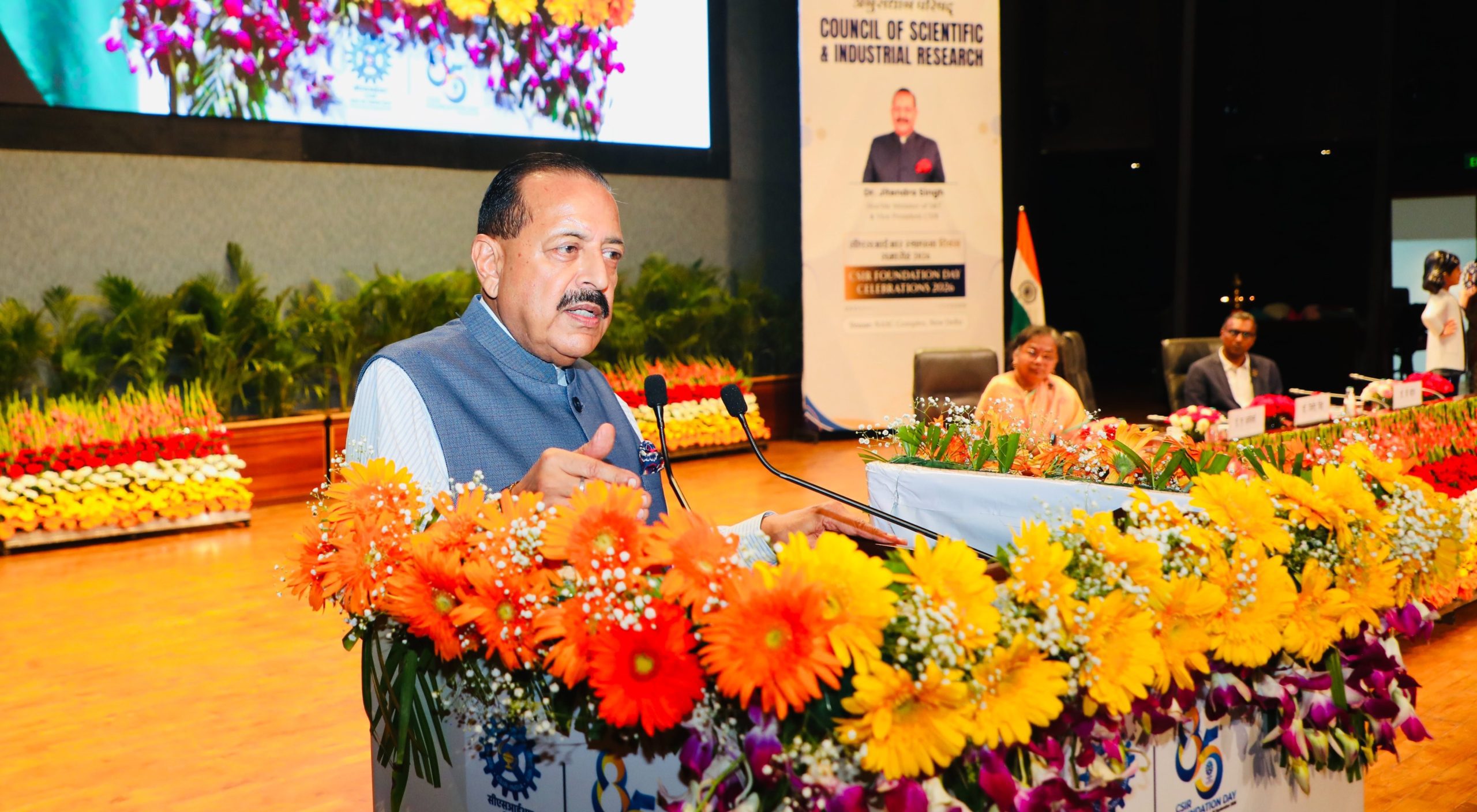
Technological sovereignty is crucial to national sovereignty and India cannot remain indefinitely dependent on imported technologies in areas critical to its economy, security and development, Union Minister of State (Independent Charge) for Science and Technology Jitendra Singh said on Thursday.
Addressing the 85th Foundation Day celebrations of the Council of Scientific and Industrial Research (CSIR) at C R Subramaniam Hall, NASC Complex, Pusa, Singh said CSIR laboratories should identify areas of critical technological dependence and develop indigenous solutions that are globally competitive in performance, quality and cost.
India’s ambition, he said, should go beyond import substitution and extend to becoming a technology provider to the world.
The event was attended by N Kalaiselvi, Secretary, Department of Scientific and Industrial Research (DSIR) and Director General, CSIR, directors of CSIR laboratories, senior scientists, researchers, government officials, industry representatives, startups and other stakeholders. More than 40 ambassadors from 14 countries also attended and visited CSIR exhibitions.
Singh said CSIR was among the institutions that had contributed significantly to India’s scientific journey after Independence, having begun its own journey in 1942. He said the organisation had built a rich scientific legacy over more than eight decades and developed capabilities across a wide range of fields.
The minister said the challenge before CSIR was to build on this legacy by continuously aligning its scientific and technological work with the country’s present and future requirements.
Referring to the diverse achievements of CSIR laboratories, Singh said their contributions had increasingly become associated with the identities of different states and regions. He cited work in areas including leather technology, jewellery, healthcare, agriculture, road technology, food technology and aerospace.
He said a significant change over the past decade had been the greater visibility of scientific achievements and their closer connection with citizens. Scientific work had existed earlier as well, he said, but its outcomes were now reaching people in a more visible and direct manner.
Singh stressed the need to shorten the journey from laboratory to industry and from discovery to deployment, calling for stronger industry linkages from the beginning of research projects.
The traditional approach of developing a technology in a laboratory and subsequently seeking an industry partner should give way to a model in which industry is involved from the stage of defining the problem itself, he said.
“Industry should be a co-creator, not only a partner,” Singh said, adding that scientists understood the scientific and technological possibilities, while industry had knowledge of markets, scale, costs and customer requirements.
Bringing these capabilities together from the outset, he said, could improve the prospects of successful technology translation.
The minister called for deeper and sustained partnerships between CSIR laboratories and relevant industries and encouraged large companies, MSMEs and startups to regard CSIR institutions as R&D partners. He said technology development should take into account market requirements and the ability to scale and sustain innovations.
Singh also said technological sovereignty had become increasingly important amid a rapidly changing global environment. India, he said, needed to reduce dependence on external sources for critical technologies and strengthen its capabilities in areas such as nuclear energy, clean energy and other emerging fields.
Referring to the National Quantum Mission, IndiaAI Mission and India Genome Mission, he said India had adopted a cross-generational and cross-ministerial approach to science and technology. The approach, he said, reflected a broader whole-of-government and whole-of-nation effort to address emerging technological challenges.
Singh said CSIR must remain an “all-time relevant” scientific organisation by continuously renewing its research priorities rather than relying on past achievements. He cited emerging technologies and applications from CSIR laboratories, including electric tractors, indigenous pharmaceutical technologies, food technologies, continuous-flow processes, advanced road technologies, solar technologies and mechanised sewer-cleaning solutions.
He also stressed the need to make scientific institutions more accessible to society and said greater public engagement could help citizens understand research and technologies being developed in laboratories.
During the celebrations, Singh unveiled CIRA, CSIR’s Innovation and Research Ambassador, the organisation’s new mascot. He also released the CSIR@85 special postal stamp, CSIR Industry Connect video and CSIR Technology Compendium.
The programme also featured the CSIR-Industry Technology Exhibition, technology transfers and the CSIR Sci-Art Gallery showcasing scientific achievements, technology development, industry engagement and public outreach.
In her welcome address, Kalaiselvi described CSIR@85 as a historically and strategically significant milestone. She highlighted CSIR’s network of 37 laboratories and more than 10,000 personnel working across diverse scientific and technological domains.
Singh said the achievements of CSIR represented the collective contribution of generations of scientists, engineers, researchers, technical personnel, administrative officials and support staff.
As India works towards the vision of Viksit Bharat 2047, Singh said CSIR had a distinctive responsibility because its own journey had begun before Independence. While India was preparing long-term roadmaps for 2030 and 2047, CSIR should aspire to carry its legacy beyond 2047, he said.
“When India reaches 2047, I wish CSIR would have lived up to its legacy and travelled and progressed beyond 2047,” the minister said.
He said the next phase of CSIR’s journey should focus on faster translation of research into technology, stronger industry partnerships, greater technological self-reliance and continued relevance to India’s emerging national requirements.
With its scientific strength spread across 37 laboratories, CSIR, he said, had the institutional capacity to contribute to technologies that would shape India’s journey towards 2047 and beyond.


