







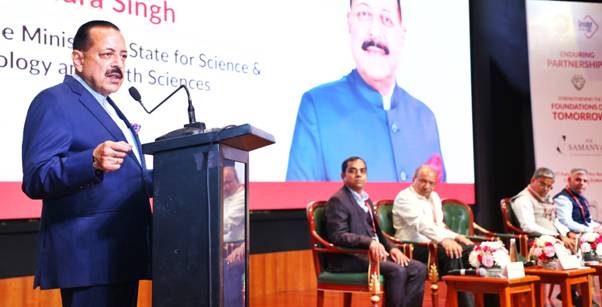
Union Minister of State (Independent Charge) for Science & Technology and Earth Sciences, Dr. Jitendra Singh, on Thursday, urged industry to partner with researchers from the conception of projects through development, scale-up, and commercialisation to accelerate India’s technological progress.
Addressing the third edition of IITK Samanvay 2026 at Bharat Mandapam in New Delhi, he called for greater domestic and international investment in deep technologies and a stronger culture of research philanthropy, describing scientific research as “as good as worship” for its potential to save lives and contribute to national development, according to a press release by the Ministry of Science and Technology.
Organised by the Indian Institute of Technology Kanpur (IIT Kanpur) under the theme “Emerging Technologies, Enduring Partnerships,” IITK Samanvay 2026 brought together stakeholders from government, industry, academia, startups and research institutions to strengthen collaboration and accelerate the translation of research into market-ready technologies and societal solutions. Prof. Amey Karkare, Dean of Resources & Alumni; Prof. Braj Bhushan, Deputy Director; and Prof. Manindra Agrawal, Director, IIT Kanpur, were present on the dais.
Industry Must Become a Co-Creator in Research and Innovation
Dr. Jitendra Singh said industry must engage with researchers from the earliest stages of a project, helping identify practical applications, develop viable business models and scale up innovations. Calling for a shift from conventional collaboration to co-creation, he urged industry leaders to accelerate the journey “from lab to land, from idea to impact, and from prototype to product.”
The Minister said India had abundant scientific talent, creativity and innovation capacity, but translating these strengths into globally competitive technologies required greater financial resources and stronger industrial participation. He called on industry to work with the government and research institutions to develop commercially viable investment models for frontier and deep technologies, with greater participation from domestic and international investors.
₹1 Lakh Crore RDI Fund to Boost Deep-Tech Investment
Referring to the ₹1 lakh crore Research, Development and Innovation (RDI) Fund announced by Prime Minister Narendra Modi in November last year, Dr. Jitendra Singh said the initiative was intended to accelerate industry participation in deep-tech development. He also highlighted the liberalisation of foreign direct investment in strategic sectors, including nuclear energy, as part of efforts to mobilise resources for India’s technological ambitions.
Calls for Greater Philanthropic Support for Scientific Research
Dr. Jitendra Singh called for a stronger culture of philanthropy in scientific research, saying that supporting research could make a direct contribution to human welfare. While philanthropy in education and other social causes remained valuable, he said investment in scientific research and clinical trials could also help advance life-saving interventions.
Referring to a recent successful trial related to haemophilia, a disorder associated with a deficiency of clotting factor VIII, the Minister said greater philanthropic support could help scientific institutions advance research and medical interventions. He encouraged philanthropists and other stakeholders to recognise scientific research as an important avenue for contributing to society and national development.
India Poised to Shape the Next Phase of Technological Progress
Dr. Jitendra Singh said India was witnessing a significant transformation in science and technology, supported by an enabling policy environment and a growing emphasis on future-ready initiatives. Unlike earlier industrial revolutions, in which India adopted several technologies after they had advanced elsewhere, the country now had an opportunity to help shape the next phase of technological progress.
With India advancing in artificial intelligence, quantum technologies and biotechnology, the country was moving into fields expected to drive the next industrial revolution, he said, also referring to initiatives such as Genome India.
Space Startups and Biomanufacturing Reflect Growth in Innovation
Citing the opening of the space sector to private participation in 2019–20, the Minister said India’s space startup ecosystem had grown from single-digit numbers to more than 400 startups. He placed the country’s space economy at around USD 9 billion, with projections of reaching USD 45 billion by the end of the decade.
Dr. Jitendra Singh also referred to the growth of India’s startup ecosystem to around 2.5 lakh startups and the expansion of the biomanufacturing sector from approximately USD 10 billion to nearly USD 200 billion over about a decade. He attributed these developments to policy support, an enabling ecosystem and a greater emphasis on innovation and entrepreneurship.
National Research Foundation to Strengthen Research Ecosystem
The Minister said the National Research Foundation was an important institutional mechanism for strengthening India’s research ecosystem. Its approach brings together scientific expertise with perspectives from social sciences, humanities and traditional knowledge, broadening the societal relevance of research and its contribution to national priorities.
He said India’s long-term development would depend on its ability to build self-reliance through indigenous manufacturing, technology development and the effective use of domestic resources. Scientific and technological self-reliance, he added, would also shape India’s geopolitical sovereignty and standing in the international arena.
Technology Key to India’s Long-Term Development Goals
Referring to India’s ambition of achieving 100 GW of nuclear energy capacity by 2047 and net-zero emissions by 2070, Dr. Jitendra Singh stressed the importance of sustained technological innovation in meeting the country’s long-term development goals.
He said platforms such as IITK Samanvay must translate dialogue into enduring partnerships, investment and measurable outcomes. Closer collaboration among government, industry, academia, startups and researchers, backed by sustained investment and a stronger culture of scientific philanthropy, would help accelerate innovation, strengthen indigenous technological capabilities and advance the vision of Viksit Bharat 2047.
-PIB Inputs


