







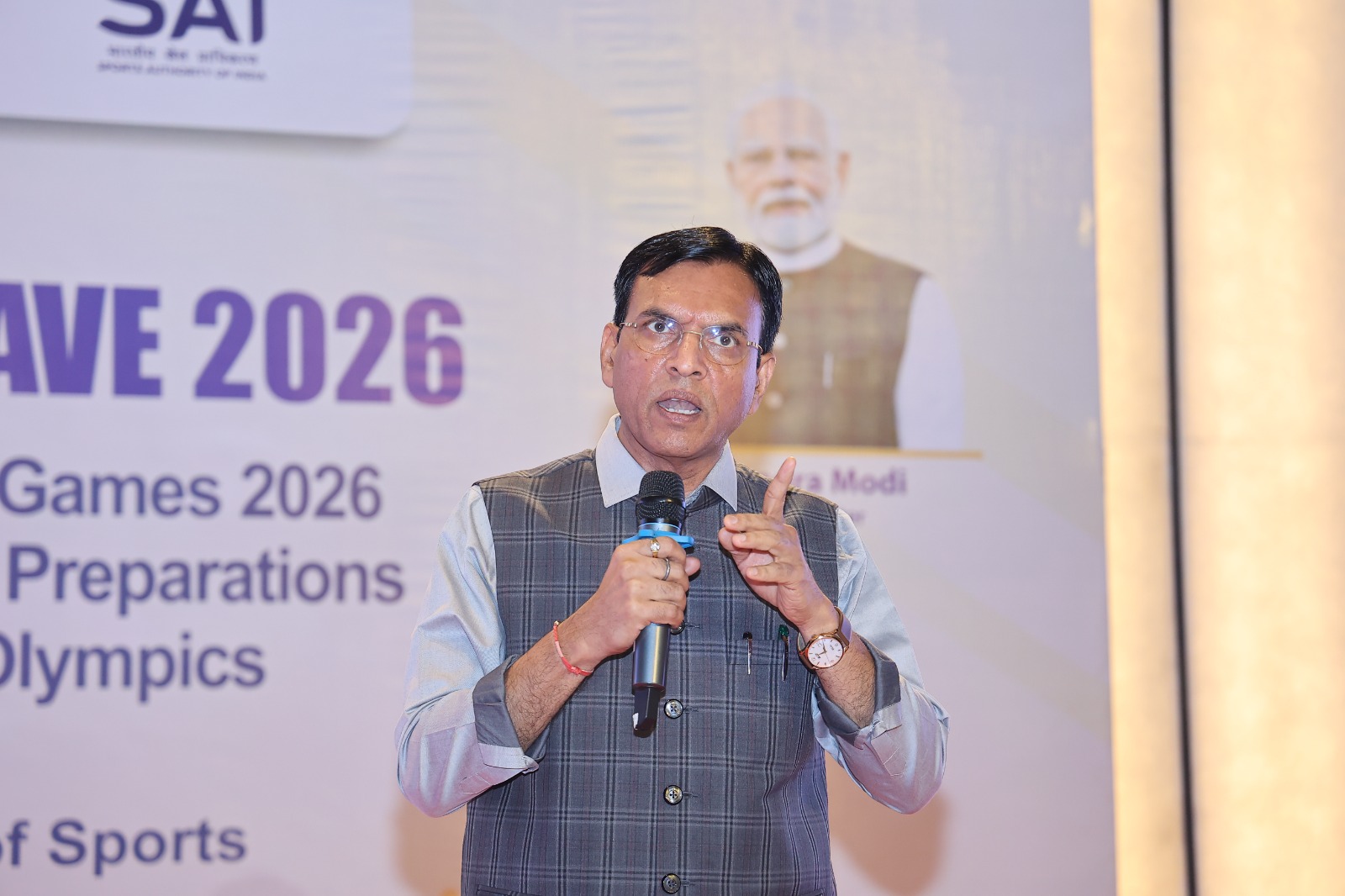
Union Sports Minister Dr Mansukh Mandaviya on Thursday urged National Sports Federations (NSFs) to strengthen talent identification, athlete development and training systems to sustain India’s sporting success, following the country’s fourth-place finish at the 2026 Asian Games. At a review meeting with NSF representatives in New Delhi, he called for greater coordination and collective responsibility to build a stronger pipeline of champions ahead of upcoming international sporting events.
Dr Mandaviya stressed that India must develop a continuous pipeline of champions rather than rely on a handful of medal winners. “How long will Mirabai Chanu alone keep winning medals for us? We need to produce 10 more Mirabai Chanus. Every federation must take this responsibility seriously. We have to identify talent, provide the right training and create an environment in which athletes can progress to the highest level,” he said.
The conclave reviewed India’s performance at the 2026 Asian Games and assessed preparations for the Los Angeles 2028 Olympics, the 2030 Commonwealth Games and the 2030 Asian Games in Doha. Representatives from major NSFs, including those governing shooting, athletics, boxing, archery, squash and wushu, attended the meeting.
The Sports Minister also emphasised the need to strengthen sports science support, including through more sports psychologists, sports science experts and high-performance mental trainers, to help athletes maintain focus at major international competitions. He urged federations to organise more competitions, improve athlete preparation and undertake an honest assessment of gaps in performance and administration.
Minister of State for Youth Affairs and Sports Raksha Khadse urged federations to align their efforts with the vision of the Khelo India Mission. She stressed that state- and district-level federations must be established and function effectively, alongside systematic talent identification and athlete development.
“Identifying talent is only one part of the process; athletes must also receive the correct training and support to reach their potential,” Khadse said, adding that collective efforts were essential to strengthen athlete preparation, establish clearer pathways for emerging talent and improve India’s medal tally.
During the conclave, Vineel Krishna, Joint Secretary (Khelo India), presented a discussion on convergence between the Khelo India Scheme and NSFs. Col. N.S. Johal, CEO (TOPS), presented a performance review of the Aichi-Nagoya Asian Games and an assessment of preparations for the 2028 Los Angeles Olympics. The revised Assistance to National Sports Federations (ANSF) guidelines booklet was also released.
Secretary (Sports) Hari Ranjan Rao said India should aim to finish among the top three at the 2030 Asian Games in Doha. He also called on federations to treat the 2030 Commonwealth Games, which India is scheduled to host, as a major national challenge and prepare to surpass the country’s performance at the 2010 Commonwealth Games.
“We have to strive to finish third at the Asian Games in Doha. For the 2030 Commonwealth Games, we must break our own record from the 2010 Commonwealth Games and finish among the top three. Since we are hosting the Games, every NSF must take the competition seriously and prepare accordingly. We must treat this as a challenge and work towards it from now,” Rao said.
Earlier, Rao had described India’s sporting ecosystem as a four-tyre vehicle that could move forward only through coordinated efforts by all its key stakeholders: athletes, coaches, NSFs, and the Ministry of Youth Affairs and Sports along with the Sports Authority of India (SAI).
-PIB Inputs


