







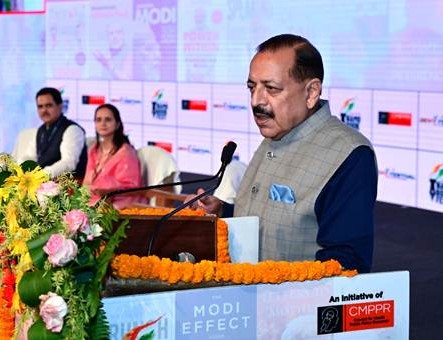
The opening of India’s space sector to private players has helped reduce the need for young scientific and technical talent to look abroad for employment while creating new opportunities within the country, Union Minister of State (Independent Charge) for Science & Technology and Earth Sciences and MoS PMO, Personnel, Public Grievances and Pensions, Atomic Energy and Space, Dr Jitendra Singh, said on Thursday.
The Minister said the emergence of private space startups, including Skyroot, has expanded the domestic space ecosystem and enabled young engineers and professionals to participate in a sector that was earlier largely government-led. The opening up of the sector, he said, marks a fundamental shift in India’s scientific ecosystem, bringing government institutions, private industry, startups, academia and research institutions together to build globally competitive capabilities.
From Government-led Sector to Wider Space Ecosystem
Dr Jitendra Singh was addressing students at the NaMo Book Fest at the Rudraksh International Cooperation and Convention Centre in Varanasi. The two-day festival, held on October 7-8, commemorates 25 years of Prime Minister Narendra Modi as Head of Government through books by different authors on various facets of his life, leadership and public service. The festival was coordinated by senior journalist Ashok Shrivastava.
During an hour-long interaction and panel discussion with students, Dr Jitendra Singh explained how the expansion of the space sector has opened avenues for young professionals within India. “The age of silos is over,” he said, underlining the need for government institutions, private industry, startups, academia and research institutions to work together to build capabilities that can compete globally, according to a press release by the Department of Space.
The Minister’s introductory address was followed by the interaction and panel discussion. The panel included Banaras Hindu University Vice-Chancellor Professor Ajit Kumar Chaturvedi; Dr Sunil Kumar from the ocean sciences sector; Dr Ekta from the Department of Science & Technology; Dr Geeta from the Department of Biotechnology; and Dr Jay Jaiswal from the space sector.
India’s Space Economy Poised for Major Expansion
India’s space economy has already reached around USD 9 billion and, if the present momentum continues, could expand to USD 45-46 billion over the next 8-10 years, Dr Jitendra Singh said.
He attributed the growth to the opening of the sector and the participation of a wider range of stakeholders in India’s space journey. The transformation, he said, is creating opportunities not only for established institutions but also for startups and young professionals entering the sector.
Space Technology Moving Beyond Rockets and Launch Missions
India’s space story is no longer confined to rockets and launch missions, with space technology increasingly being used to improve everyday life, the Minister said.
He cited applications in infrastructure planning, project monitoring and disaster management. Indian satellites are also providing information to neighbouring countries, including Nepal, Bangladesh, Myanmar and Sri Lanka, to help them prepare for floods and other disasters, he said.
‘Era of Science’ Driving India’s Scientific Transformation
Taking students through India’s broader scientific transformation, Dr Jitendra Singh described the last 12-13 years as an “Era of Science”, with technology receiving greater policy priority and being increasingly deployed to improve people’s lives.
India has long possessed scientific talent and human resources, but the enabling policy environment required to convert that potential into national capability has strengthened significantly in recent years, he said.
The Minister cited the Deep Ocean Mission, National Quantum Mission, Artificial Intelligence, Cyber Security and the Anusandhan National Research Foundation among initiatives aimed at building capabilities in emerging areas of science and technology.
Referring to the Deep Ocean Mission, he said India is beginning to explore the vast scientific and economic potential of its oceans, including resources that have remained largely unexplored.
Biotechnology Strengthening Indigenous Capabilities
On biotechnology, Dr Jitendra Singh highlighted India’s policy framework focused on “Biotechnology for Economy, Environment and Employment”, the development of the world’s first DNA vaccine against COVID-19 and the Genome India initiative as examples of the country’s growing indigenous capabilities.
These initiatives, he said, are also helping prepare India for an era of precision medicine and expanding the scope for research and innovation in biotechnology.
Chandrayaan-3 Reflects India’s Growing Space Capabilities
Referring to Chandrayaan-3, the Minister said India has demonstrated its ability to undertake sophisticated space missions with remarkable cost efficiency.
India has moved beyond an earlier phase of largely following developments elsewhere and is now progressing alongside the world, with the country already ahead in several areas, he said.
Private Participation in Nuclear Sector, Higher Research Spending
Dr Jitendra Singh also referred to the opening of the nuclear sector to private participation and India’s target of achieving 100 GW of nuclear energy capacity by 2047.
Nuclear power, he said, is emerging as an important clean-energy source for India’s future requirements, including the growing energy needs of Artificial Intelligence and data centres.
The increased priority accorded to research is also reflected in the rise in Gross Expenditure on Research and Development (GERD), which has increased from around Rs 46,000-47,000 crore in 2013-14 to around Rs 2-2.5 lakh crore, he said.
AI Should Augment Human Capability, Not Replace Human Thinking
Responding to students on Artificial Intelligence, Dr Jitendra Singh encouraged them to embrace the technology while retaining independent thinking and curiosity.
“You have to be intelligent enough to use Artificial Intelligence,” he said, stressing that technology should strengthen human capability rather than replace the curiosity that drives scientific discovery.
Science and Innovation Driving India Towards Viksit Bharat
The country’s scientific progress has created a new sense of confidence and expanded opportunities for its youth, Dr Jitendra Singh said.
Recalling Prime Minister Narendra Modi’s message, “We can do it,” he said India has moved from an era when the world experimented and India followed to one in which scientific developments are taking place in India alongside the rest of the world, with the country moving ahead in several fields.
The next phase, he said, will depend on sustained collaboration, greater opportunities for young talent and the continued conversion of scientific capability into innovation, economic opportunity and solutions for everyday life as India advances towards Viksit Bharat.
-PIB inputs


